Alignment vs Clamping in Fixtures: What Engineers Need to Know for Accurate Workholding
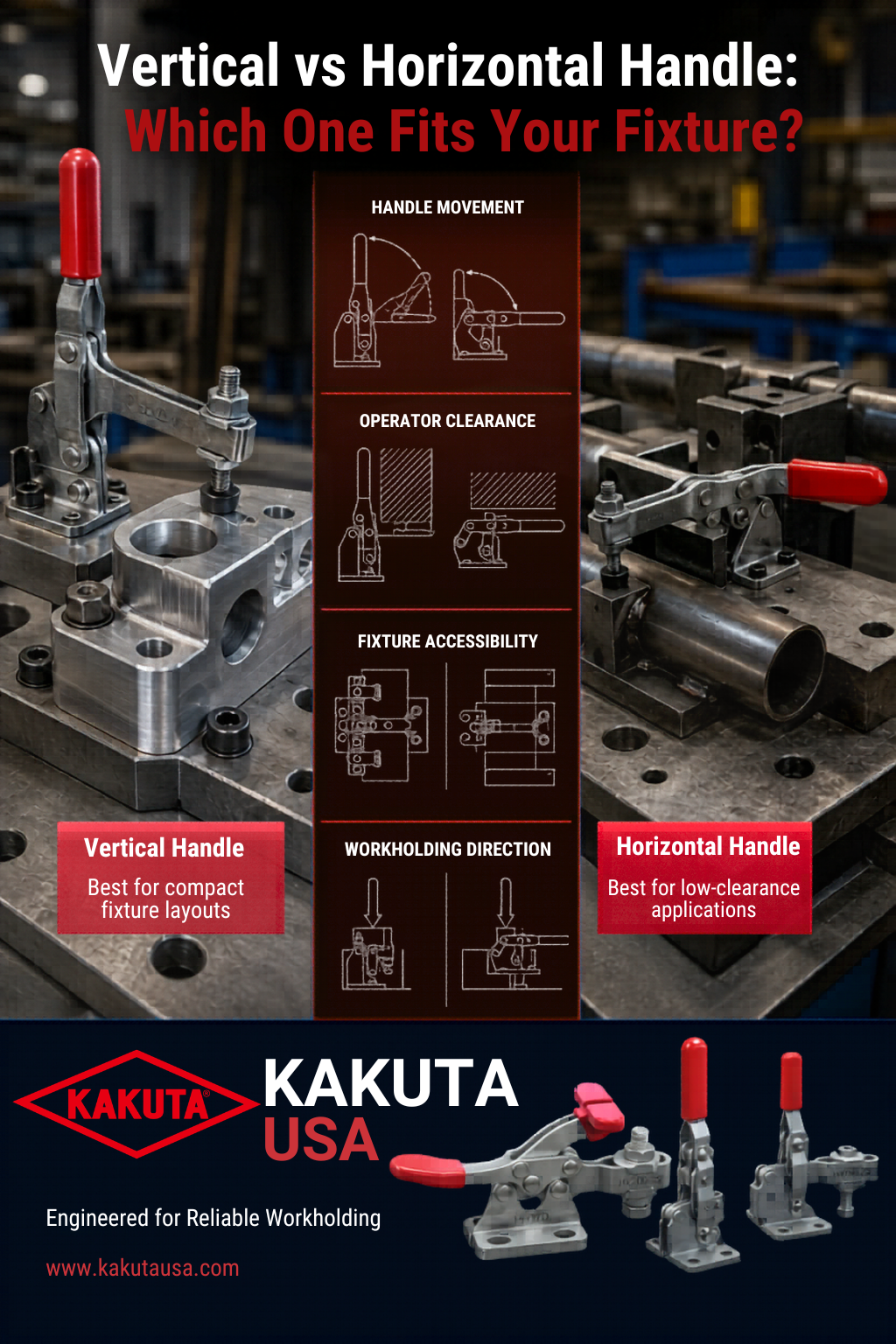
Vertical and horizontal toggle clamps — both required for repeatable, locked workholding
In fixture design, alignment and clamping are often discussed as if they're the same job. They aren't. Alignment positions the part. Clamping holds it there.
Confuse the two, and you'll see scrap rates rise, tolerances drift, and operators chasing problems that started at the workholding stage. This guide breaks down the difference between alignment and clamping, why each one matters, and how engineers can build fixtures that deliver consistent, repeatable accuracy across every cycle.
Alignment positions a part in the correct location. Clamping holds that part in place against cutting forces, vibration, and movement. Accurate workholding requires both — alignment defines where the part sits, and clamping ensures it stays there throughout the operation.
Why This Matters in Fixture Design Basics
Workholding is the silent variable in manufacturing accuracy. A CNC machine can hold sub-thousandth tolerances, but if the fixture allows the part to shift by even 0.05 mm under cutting load, the part is out of spec.
Understanding alignment vs clamping is the foundation of reliable workholding systems — whether you're building a drill jig, a welding fixture, or a high-volume production cell.
What Is Alignment in Fixture Design?
Alignment is the positioning function of a fixture. Its job is to place the workpiece in the exact same location, in the exact same orientation, every single time.
Alignment uses passive components, including:
- Locating pins — fix the part in X and Y axes
- Stops and rest blocks — define datum surfaces
- V-blocks and cradles — locate cylindrical or contoured parts
- Guides and bushings — align tools to predetermined paths
These elements don't apply force. They simply define where the part belongs. Think of alignment as the blueprint — it tells the part where to go, but it doesn't make the part stay.
What Is Clamping in Workholding?
Clamping is the active function of a fixture. It applies controlled force to secure the part against the locators so it cannot move during the operation.
Common clamping methods used in industrial workholding include:
Kakuta has manufactured these clamp types since 1959, and the principle behind them hasn't changed: a mechanical lever multiplies operator input into a consistent, repeatable holding force — and locks it.
Key Difference: Alignment vs Clamping
The cleanest way to understand the relationship:
Alignment
- Positions the part
- Passive (no force applied)
- Defines location
- Sets accuracy
- Static reference
Clamping
- Secures the part
- Active (applies force)
- Prevents movement
- Maintains accuracy
- Dynamic load resistance
Both are required. Alignment without clamping leaves the part free to move. Clamping without alignment secures the part — but in the wrong place.
Why Alignment Alone Fails
Engineers sometimes assume that if a part is correctly located, it will stay correctly located. In real production, that almost never holds true.
Here's what acts on an "aligned but unclamped" part during machining:
- Cutting tool pressure pushes the part away from the cutter
- Vibration from spindle harmonics walks the part out of position
- Chip loading lodges debris between the part and the locator
- Thermal expansion during long cycles shifts datum surfaces
- Operator handling between operations introduces small misplacements
Any one of these is enough to produce inconsistent results. Combined, they guarantee scrap. Alignment is necessary, but it is not sufficient on its own.
How Toggle Clamps Solve This
Toggle clamps convert alignment from a hopeful starting point into a locked, repeatable condition. They do this through a simple mechanical advantage: a linkage that travels over-center, locking the clamp closed under load.
Key benefits for fixture engineers:
- Consistent holding force — the toggle locks at a defined position every cycle
- Repeatability — the clamp returns to the same closed state without operator calibration
- Fast cycle times — single-handle actuation reduces setup between parts
- Compact footprint — toggle geometry fits where pneumatic or hydraulic clamps cannot
- No external power — purely mechanical, with no air lines or hoses to manage
Locked. Trusted. Engineered for Vibration.
Within Kakuta's range, the Release-Lock Toggle Clamp Series adds a secondary lock that prevents accidental release under vibration — a feature designed specifically for fixture applications where unintended unclamping is a safety or quality risk.
Real Manufacturing Example: A CNC Milling Fixture
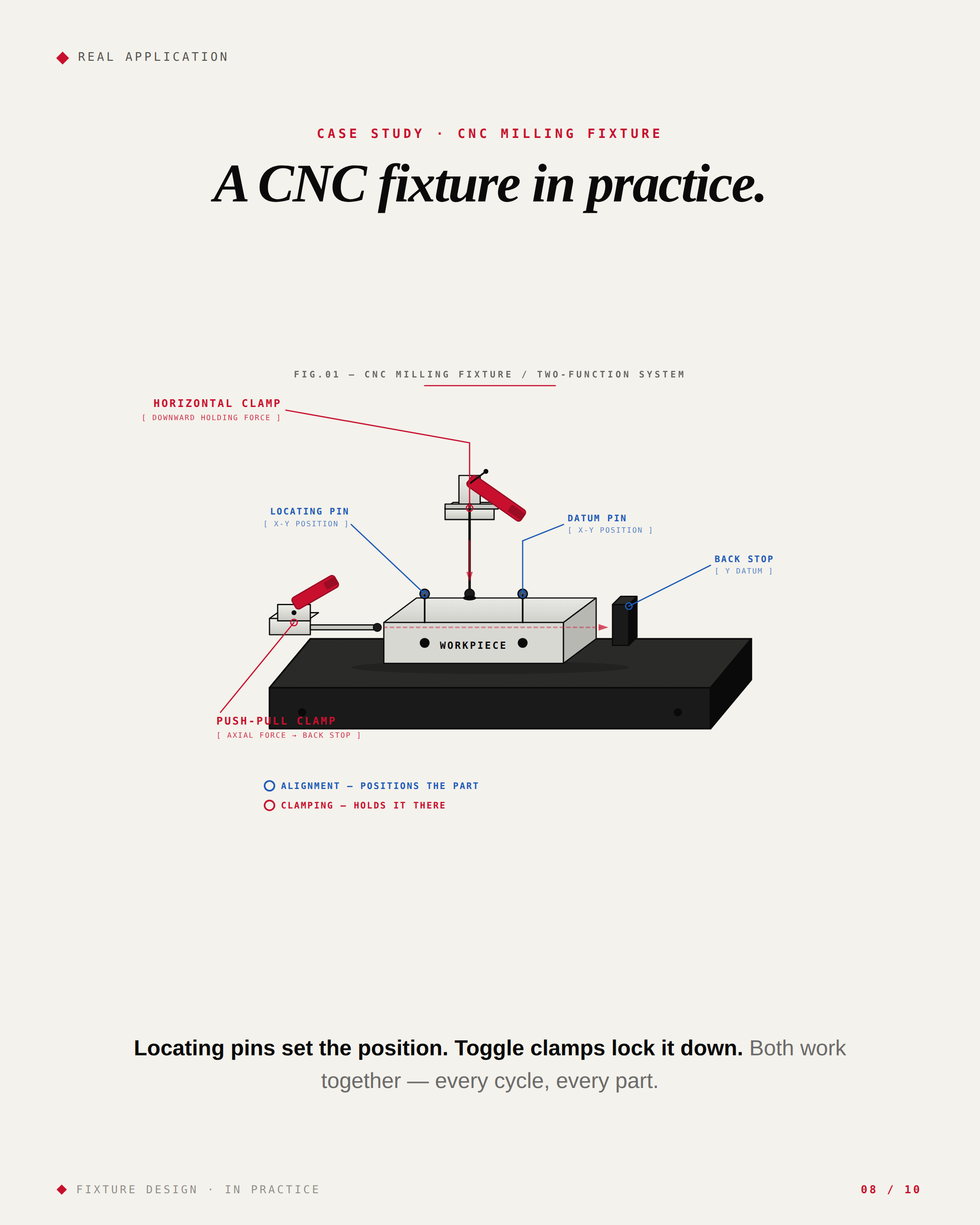
Consider a fixture that holds a small aluminum bracket for a 3-axis CNC operation.
Alignment Components
- Two diamond and round locating pins establish the X-Y position
- A back stop establishes the Y datum
- A flat support plate establishes the Z datum
Clamping Components
- One horizontal toggle clamp applies downward force on the bracket
- One push-pull clamp holds the bracket against the back stop
The locating pins and stops define where the bracket sits. The toggle clamps ensure the bracket doesn't lift, slide, or rotate when the cutter engages. Remove the clamps and the locators do nothing under load. Remove the locators and the clamps secure the part in the wrong position. Both work together — that's the principle.
The same logic applies to welding fixtures, assembly jigs, drilling templates, and inspection setups across the manufacturing floor.
Common Mistakes Engineers Make
A few patterns we see repeatedly in fixture reviews:
- Relying on alignment alone — assuming a snug-fitting locator will hold the part during machining
- Under-clamping — using a clamp with insufficient holding capacity for the cutting load
- Poor clamp placement — applying force away from the cutting zone, allowing the part to flex
- Uneven force distribution — using a single clamp where two are needed, creating a pivot point
- Mixing locator and clamp duties — using a clamp as a locator, which compromises both functions
Most fixture failures aren't catastrophic. They show up as inconsistency: one part in twenty drifts out of tolerance. That's almost always a clamping issue, not an alignment issue.
How to Choose the Right Toggle Clamp
Selecting a clamp comes down to four practical factors:
- Holding force required — Match the clamp's rated capacity to the cutting or process load, with a safety margin. A toggle clamp specified at its maximum rating in continuous production is a clamp ready to fail.
- Available space and orientation — Vertical clamps suit compact fixtures with overhead clearance. Horizontal clamps work where downward force is needed across a flat surface. Push-pull and latch clamps suit linear or split-fixture geometries.
- Operation type and cycle time — High-volume cells benefit from quick-release toggle action. Lower-volume or precision setups may favor adjustable spindle clamps for fine control.
- Frequency of use and environment — Heavy-duty production demands clamps with locking features and durable construction. Welding environments need spatter-resistant designs. CNC environments favor low-profile, vibration-resistant clamps.
For a complete walkthrough of clamp types and selection criteria, see our guides on horizontal toggle clamps and vertical toggle clamps.
Conclusion: Alignment + Clamping = Accuracy
Precision manufacturing isn't about choosing between alignment and clamping. It's about engineering both to work together.
Alignment defines the geometry. Clamping defends it. When one is weak, the entire fixture is weak — regardless of how sophisticated the rest of the process is.
Engineers who design fixtures with this principle in mind build production systems that are faster to set up, easier to operate, and consistently accurate over thousands of cycles.
Frequently Asked Questions
What is the difference between alignment and clamping in fixture design?
Alignment positions a part in its correct location using passive components like locating pins, stops, and guides. Clamping applies active force — typically through toggle clamps — to hold the part in that position against vibration, cutting loads, and movement.
Why is clamping important in workholding fixtures?
Without clamping, even a perfectly aligned part will shift under cutting forces, vibration, and chip loading. Clamping is what turns alignment from a starting condition into a stable, repeatable working condition throughout the machining cycle.
Can alignment alone ensure manufacturing accuracy?
No. Alignment defines where the part should sit, but it doesn't apply force. Without clamping, the part is free to shift during machining, welding, or assembly — leading to inconsistent results and increased scrap rates.
What type of toggle clamp is best for CNC workholding?
The right choice depends on the fixture geometry, holding force required, and available space. Horizontal toggle clamps suit flat-surface setups, vertical toggle clamps suit tight overhead spaces, and push-pull clamps suit linear applications. For vibration-prone environments, locking-action clamps such as Kakuta's Release-Lock Series are recommended.
How many clamps should a fixture have?
The general principle is that clamping force should be distributed to prevent pivoting or flexing of the part under load. Most production fixtures use two or more clamps positioned to balance the cutting forces — the exact number depends on part geometry, machining strategy, and load direction.
Build fixtures that hold — every cycle.
Kakuta has produced precision toggle clamps since 1959, supporting engineers and manufacturers across CNC, welding, assembly, and jig applications worldwide.