

Horizontal vs Vertical Toggle Clamps: An Engineer's Guide
Horizontal vs. Vertical Toggle Clamps: An Engineer's Guide to the Right Hold-Down
Same fixture, same workpiece — but a horizontal and a vertical toggle clamp behave very differently in it. The right choice comes down to three things: clearance, access, and the direction you need to hold.
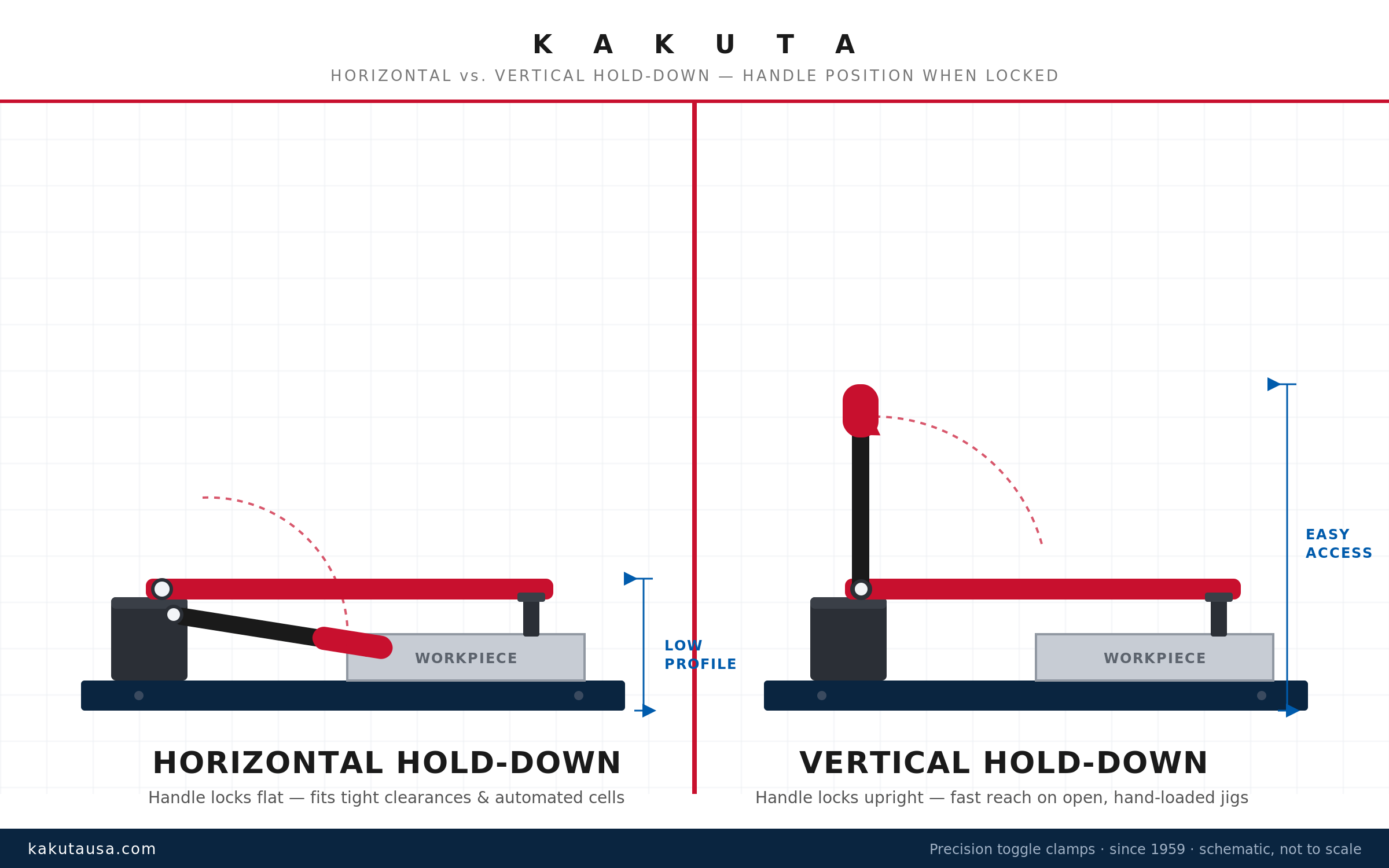
Ask two engineers which toggle clamp to spec for a fixture and you'll often get two answers — not because one is wrong, but because they're picturing different constraints. Toggle clamps are deceptively simple: an over-center linkage that locks a workpiece down and holds it there under load. The mechanism is the same. What changes between a horizontal and a vertical hold-down is the geometry of how the handle moves and where the clamping force is applied — and that geometry decides whether the clamp fits your fixture, clears your tooling, and holds the part the way the job needs.
This guide walks through the practical difference between the two, how clearance and operator access change the answer, and a quick decision framework you can apply to your next fixture.
The Core Difference: Handle Motion and Hold Direction
The names describe the handle, not the workpiece. On a horizontal hold-down clamp, the handle swings down and locks in a flat, horizontal position — roughly parallel to the mounting base. On a vertical hold-down clamp, the handle locks in an upright, vertical position above the base. Both clamp the part downward onto the fixture; the split is in how much room the handle needs to get there and where it ends up when locked.
That single distinction cascades into everything else — the height profile of the clamped fixture, how close you can pack clamps together, whether an operator can reach the handle in a loaded machine, and whether the clamp arm clears the tooling path. None of it changes the holding principle. All of it changes which clamp belongs in your fixture.
Horizontal Hold-Down Clamps
A horizontal toggle clamp keeps its handle low. When locked, the handle lies down flat rather than standing up, which keeps the whole assembly under a defined height line. That low profile is the reason engineers reach for horizontal clamps in tight, enclosed, or automated setups.
Where horizontal clamps earn their place
- Tight vertical clearance. Enclosures, machine guarding, sliding covers, or a spindle path directly above the part all limit how tall the fixture can be. A handle that folds flat stays out of that zone.
- Automated and CNC cells. When a tool, gantry, or robot passes over the fixture, a locked-down flat handle removes a collision risk that an upright handle would create.
- Dense fixture layouts. Low-profile clamps can sit closer to the workpiece line, making them well suited to plates that hold several parts at once.
The trade-off is operator reach: a handle that locks flat sits lower and can be harder to grab quickly in a deep or crowded fixture. Where clearance is the constraint, that's a fair price to pay.
→ Explore Kakuta horizontal hold-down clamps (HH)Vertical Hold-Down Clamps
A vertical toggle clamp locks with the handle standing upright. That taller footprint buys back the thing horizontal clamps give up: fast, obvious, ergonomic access. The handle is easy to see, easy to reach, and quick to actuate — which matters when a fixture is loaded and unloaded hundreds of times a shift.
Where vertical clamps earn their place
- Open-top fixtures. Jigs, welding tables, and assembly fixtures with room above the part let the upright handle do its job without fighting for space.
- High-cycle manual loading. When an operator works the clamp repeatedly, an upright handle at hand height reduces fatigue and speeds the cycle.
- Frequent setup changes. A visible, easy-to-grab handle makes clamps faster to engage and release when fixtures are reconfigured often.
The trade-off is height: the raised handle needs headroom, so vertical clamps are a poor fit under low guarding or in the path of overhead tooling.
→ Explore Kakuta vertical hold-down clamps (HV)Clearance and Access: The Two Questions That Decide It
Strip the decision down and it usually comes to two questions about the space around the part — before any conversation about holding capacity.
- How much room is above the fixture? If tooling, guarding, or an enclosure crowds the space over the part, the flat-locking horizontal clamp protects your clearance. If there's open headroom, vertical is on the table.
- How does the operator (or the machine) reach the clamp? Manual, high-cycle loading favors the reach and speed of a vertical handle. Automated motion over the fixture favors the collision-free profile of a horizontal one.
Answer those two and the clamp type is usually decided. Holding force, mounting base, and spindle setup come next — important, but downstream of the geometry.
Quick Decision Guide
| If your fixture... | Lean toward | Because |
|---|---|---|
| Has tooling or guarding directly above the part | Horizontal (HH) | Flat-locking handle preserves vertical clearance |
| Sits inside an enclosure or automated cell | Horizontal (HH) | Low profile avoids collisions with passing tooling |
| Is loaded and unloaded by hand, many times a shift | Vertical (HV) | Upright handle is faster to reach and less fatiguing |
| Is an open-top jig or welding fixture | Vertical (HV) | Headroom is available and access matters most |
| Packs several clamps close together on a plate | Horizontal (HH) | Compact footprint fits dense multi-part layouts |
Common Mistakes When Choosing
- Speccing by holding force first. Two clamps can hold the same load and still be the wrong or right pick based purely on handle geometry. Confirm the type fits the space, then size the force.
- Forgetting the locked position. Engineers picture the clamp open when loading a part, then discover the locked handle collides with tooling or a cover. Check clearance in both the open and closed positions.
- Ignoring operator ergonomics. A clamp that's technically reachable but awkward slows every cycle. On high-volume fixtures, handle access is a productivity spec, not a nicety.
- Assuming one type fits the whole fixture. Mixed fixtures often use both — horizontal clamps where tooling passes over, vertical clamps where hands do the work.
Conclusion
Horizontal and vertical toggle clamps hold the same way; they fit differently. Horizontal clamps keep a low, flat profile for tight clearances and automated cells. Vertical clamps trade height for fast, ergonomic access on open, hand-loaded fixtures. Start with the two questions — clearance above the part, and how the clamp gets reached — and the right hold-down usually chooses itself. From there, match the holding force and mounting to the job.
Once you've settled on horizontal or vertical, the next step is sizing the hold. See our guide on what clamping force actually means and how to size it for your fixture.
Frequently Asked Questions
What is the difference between a horizontal and a vertical toggle clamp?
The names describe the handle position when locked. A horizontal hold-down clamp locks with the handle flat and low, roughly parallel to the base; a vertical hold-down clamp locks with the handle upright above the base. Both clamp the workpiece downward — the difference is the height profile and how the handle is accessed.
When should I use a horizontal hold-down clamp?
Choose a horizontal clamp when vertical clearance is tight — under machine guarding, inside enclosures, in automated or CNC cells where tooling passes over the fixture, or in dense multi-part layouts where a low, flat profile matters.
When should I use a vertical hold-down clamp?
Choose a vertical clamp on open-top fixtures with headroom above the part — jigs, welding tables, and assembly fixtures — especially when an operator loads and unloads by hand many times a shift and needs fast, ergonomic handle access.
Does horizontal or vertical affect how much force the clamp holds?
Handle orientation is about fit and access, not holding capacity. Holding force is set by the clamp series and model. Pick the type that fits your clearance and access first, then match the rated holding force to your application.
Not sure which hold-down fits your fixture?
Browse KAKUTA USA's horizontal and vertical toggle clamps — precision hold-downs for CNC, welding, and assembly, ready to ship from Valencia, CA.
See the full range →🔩 Looking for the Right Toggle Clamp?
Browse KAKUTA USA's full range of Release-Lock Toggle Clamps — built for precision workholding in CNC, welding, and assembly.
Shop Toggle Clamps →