

What Is Clamping Force and Why it Matters in Fixture Design
Clamping force diagram showing rated vs. actual holding force on a Kakuta HV Series toggle clamp
What Is Clamping Force and Why It Matters in Fixture Design
A clamp rated at 687 daN (700 Kg) doesn't guarantee that force at your workpiece — here's what the rating actually means, and how to size it correctly.
A clamp rated at 687 daN (700 Kg) doesn't guarantee that force at your workpiece. It guarantees that output under the test conditions printed on the spec sheet — straight-line force, full over-center engagement, no offset load. Mount that same clamp at an angle, skip the safety margin, or run it through 2,000 cycles a shift, and the number on the catalog page stops describing what's actually happening at the workpiece.
This is where most fixture problems start. Not from a clamp that's “wrong,” but from a clamp whose rated capacity was read as a working guarantee instead of a starting point.
This guide breaks down what clamping force actually measures, how to read a holding capacity rating correctly, how to calculate the force your application needs, and where engineers most often get the math — or the mounting — wrong.
Defining Clamping Force
Clamping force, also called hold-down force or holding force, is the amount of force a toggle clamp's arm exerts on a workpiece once the toggle mechanism is fully engaged. Kakuta — like most international manufacturers — publishes this figure in daN (decanewtons), the standard force unit used across European and international spec sheets.
That single number is meant to summarize a clamp's ability to resist cutting, drilling, welding, or assembly forces acting on the part. But it's a starting point for fixture design, not a complete answer. A published rating describes performance under defined test geometry — not the working capacity in every fixture it gets bolted into.
→ Explore the Kakuta HH SeriesHow to Read a Holding Capacity Rating (Rated vs. Actual)
Every toggle clamp spec sheet lists a rated holding capacity: the maximum force the clamp produces when the toggle is fully over-center and the arm is aligned with the test geometry used to establish that figure.
Actual holding force in your fixture depends on three things:
- Force direction. Ratings are typically established for force applied perpendicular to the clamp arm. Off-axis loading reduces effective holding force.
- Arm and spindle position. Holding capacity assumes correct arm length and spindle adjustment. An improperly set spindle reduces clamping pressure even on a correctly rated clamp.
- Safety factor. Most fixture designs apply a margin below rated capacity — commonly a 2:1 to 3:1 safety factor — to account for vibration, repeated cycling, and material variation.
European manufacturers commonly label this figure as nominal holding force (daN); some publish it under their own notation conventions rather than a universal symbol. The underlying measurement is the same one shown on Kakuta's spec sheets as rated holding capacity — Kakuta publishes ratings in daN across the catalog specifically so the numbers read directly against European-format spec sheets, without conversion or notation guesswork.
Calculating Required Force for Your Application
Before specifying a clamp, work backward from the application:
- Identify the maximum force acting against the part. Cutting force, drill thrust, weld distortion, and assembly pressure all count toward this number.
- Add your safety factor. A 2:1 to 3:1 margin above the calculated working force is standard practice for production fixtures — not a conservative extra, but the baseline.
- Confirm the clamp's rated capacity exceeds that total, not just matches it.
- Check force direction against your fixture geometry. A clamp rated for straight-line holding force performs differently in an angled or offset mounting.
A clamping force calculator can do the arithmetic. The engineering judgment is in steps 1 and 4 — knowing what's actually pulling, pushing, or vibrating against the part, and whether the clamp is mounted to resist it directly.
Common Clamping Force Mistakes
A few patterns show up repeatedly in fixture reviews:
- Matching rated capacity to working load with no safety margin. This leaves no buffer for cycling fatigue or part-to-part variation.
- Ignoring force direction. A clamp that performs well in straight-line testing can underperform mounted at an angle to the load.
- Sizing for static load only. Vibration and repeated cycling — common in welding and CNC fixtures — demand more holding force than a one-time static hold.
- Treating all daN ratings as equivalent. Toggle clamp capacity varies significantly across series. Holding force should be matched to the specific fixture, not assumed from a general “heavy-duty” label.
Most of these don't show up as a catastrophic failure. They show up as a clamp that loosens after a few hundred cycles, or a part that drifts 0.1mm out of tolerance on the parts nobody double-checked.
Kakuta Series: Force Ratings by Application
Kakuta's heavy-duty VH Long Life Series spans four confirmed holding-force tiers, each suited to a different production environment:
| Model | Rated Holding Force | Typical Application |
|---|---|---|
| VH 100 / VH 101 | 294 daN (300 Kg) | Entry-level heavy duty — workholding jigs and fixtures |
| VH 302 / VH 303 | 687 daN (700 Kg) | Mid-range heavy duty — automotive fixture use |
| VH 502 / VH 503 | 1,177 daN (1,200 Kg) | Industrial heavy load — high-cycle production |
| VH 601 / VH 602 | 2,354 daN (2,400 Kg) | Maximum capacity — automotive and structural jigs |
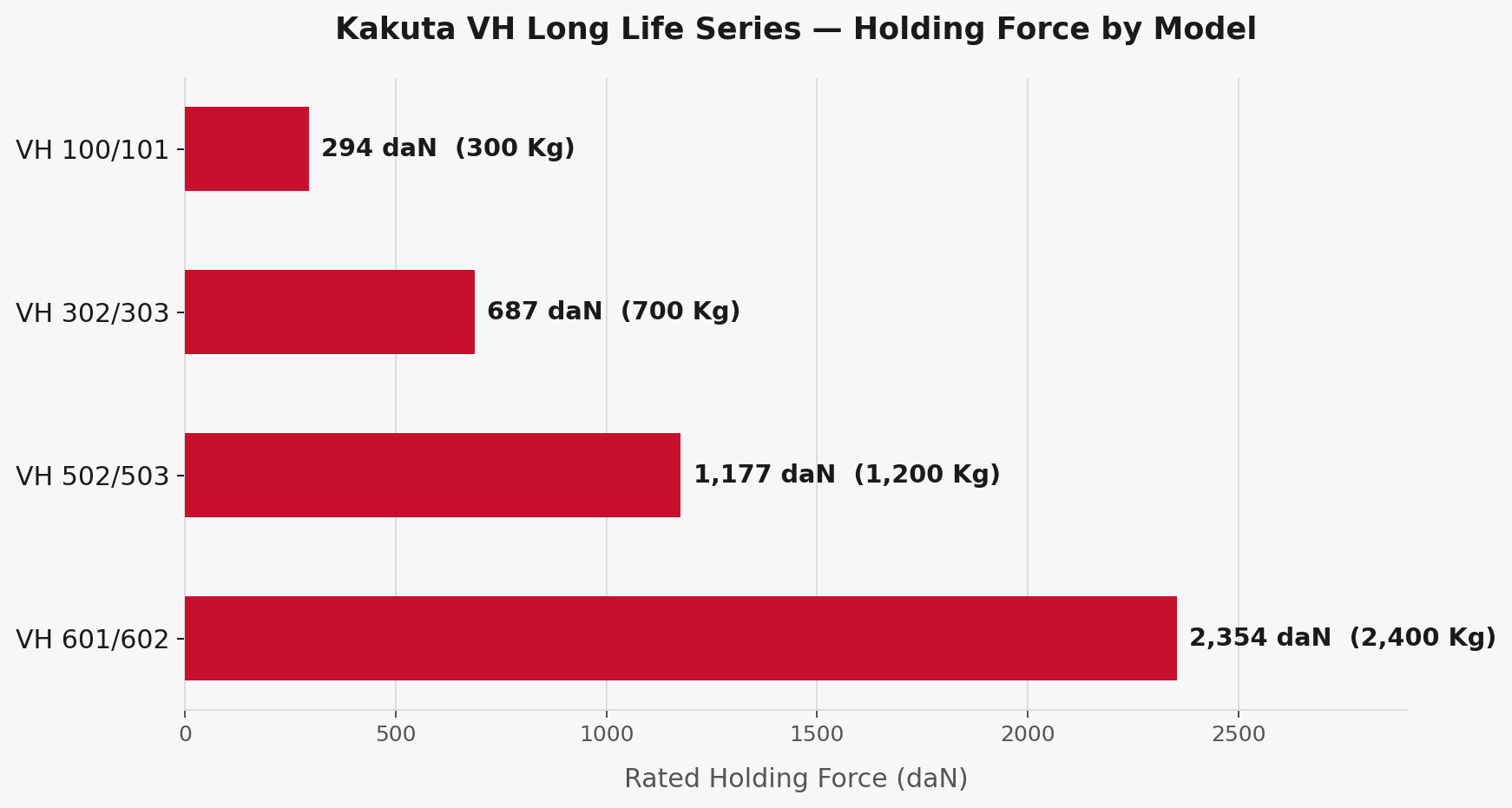
Holding force comparison across the Kakuta VH Long Life Series, 294–2,354 daN (300–2,400 Kg)
For lighter-duty applications, Kakuta's HH and HV series cover standard horizontal and vertical hold-down work where full VH-range capacity isn't required.
A note for engineers cross-referencing European spec sheets: the VH 100 through VH 602 range corresponds directly to the heavy-duty vertical series used by UK manufacturers under VA-series-style notation, and to what Italian suppliers list as Serie Verticale Pesante. Kakuta's catalogue ratings are published in Kg; daN equivalents are shown in the table above (1 Kg ≈ 0.981 daN), so the comparison against European daN-format spec sheets is a straightforward read, not a conversion exercise.
Conclusion
Clamping force is a useful spec, read correctly. Rated capacity tells you what a clamp produces under defined test conditions; actual performance in your fixture depends on direction, mounting, and safety margin. Whether you're comparing daN ratings against a European spec sheet or sizing a new fixture from scratch, start with the working force your application actually generates, build in a margin, and match it against confirmed holding capacity — not a general-duty label.
For the full breakdown of clamp types and how to match one to your fixture geometry, see our guide on how to choose the right toggle clamp.
Frequently Asked Questions
What is clamping force in a toggle clamp?
Clamping force, also called hold-down force or holding force, is the amount of force a toggle clamp exerts on a workpiece once the toggle mechanism is fully engaged. It's published in daN on most international and European-format spec sheets.
Why is rated holding capacity different from actual holding force?
Rated capacity is measured under defined test conditions — straight-line force, full over-center engagement. Actual force in your fixture depends on mounting angle, spindle adjustment, and the safety margin applied during design.
How much safety margin should I build into a clamping force calculation?
Most production fixtures apply a 2:1 to 3:1 safety factor above the calculated working force, to account for vibration, repeated cycling, and material variation.
Do Kakuta's force ratings compare directly to European toggle clamp specs?
Yes. Kakuta publishes holding force in daN, the same unit used across European spec sheets, including the conventions used by UK and Italian heavy-duty vertical clamp suppliers — so ratings can be compared directly without conversion.
🔩 Looking for the Right Toggle Clamp?
Browse KAKUTA USA's full range of Release-Lock Toggle Clamps — built for precision workholding in CNC, welding, and assembly.
Shop Toggle Clamps →🔩 Looking for the Right Toggle Clamp?
Browse KAKUTA USA's full range of Release-Lock Toggle Clamps — built for precision workholding in CNC, welding, and assembly.
Shop Toggle Clamps →