
Kakuta F Clamps vs. Bessey: An Engineer’s Comparison

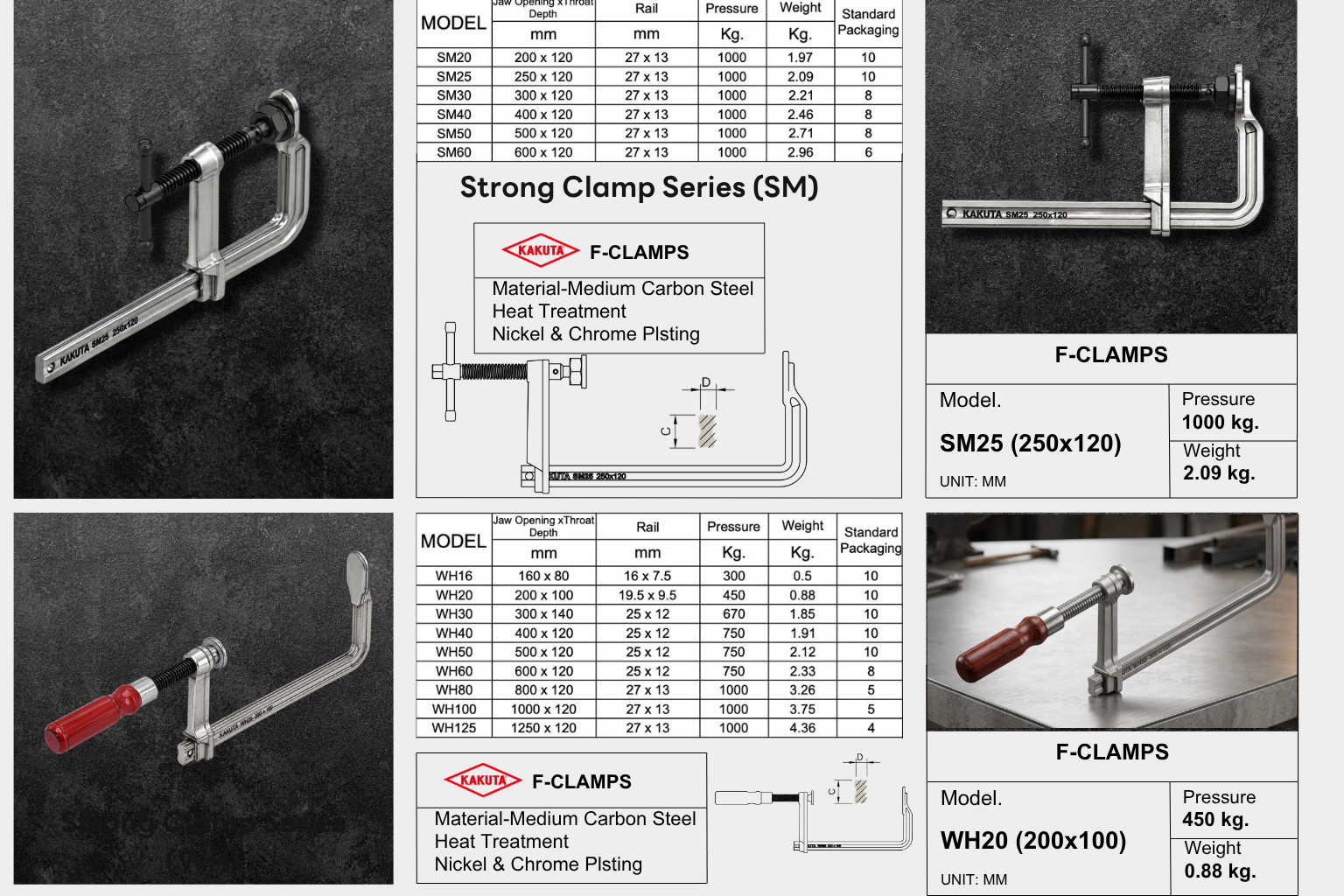
Comparison of Kakuta's Strong Clamp Series (SM) and Wood Handle Series (WH) F-Clamps, showcasing technical specifications, product dimensions, and industrial workholding solutions for engineering, fabrication, and manufacturing applications.
By the Kakuta Engineering Team · Reading time: ~6 minutes

Collage featuring Kakuta SM25 and WH20 F-Clamps with product photography, technical drawings, dimensional specifications, and performance data for industrial workholding and fixture applications.

Comparison of Kakuta's Strong Clamp Series (SM) and Wood Handle Series (WH) F-Clamps, showcasing technical specifications, product dimensions, and industrial workholding solutions for engineering, fabrication, and manufacturing applications.

If your shop runs Bessey F-clamps, you already know what a good general-purpose clamp does: hold a workpiece square while you weld, fabricate, glue, or assemble. Bessey has earned its reputation. But brand recognition isn't a technical spec — and for buyers standardizing a fixture line or managing a tooling budget, a like-for-like alternative is worth understanding.

This comparison looks at how Kakuta's six F-clamp series map against Bessey's range, where the two brands align on construction, and how to choose the right series for woodworking, metal fabrication, welding, and assembly. It's written for engineers and buyers who want specifics, not a sales pitch.

If you're earlier in the selection process, our guide on how to choose the right clamp for your application and our breakdown of clamping force and safety factor cover the fundamentals this article builds on.

What Is an F-Clamp — and Where It Fits

An F-clamp (named for its F-shaped profile) is a sliding-arm bar clamp: one fixed jaw, one jaw that slides along a bar and locks under load. It's the versatile, repositionable holding tool you reach for on benches, weld tables, and general fabrication work.

Both Kakuta and Bessey build F-clamps across a spectrum of duty levels — from light woodworking to heavy steel-structure work. The practical differences come down to series breadth, construction, cost position, and availability.

Six Series at a Glance

Kakuta organizes its F-clamps into six dedicated series, each addressing a different handle style or application, with clamping capacity from roughly 300 kg to 2,200 kg and jaw openings up to 1,500 mm:

Series Type Sizes Best For
THT-Handle10 sizes · 16–150General fabrication, high grip torque
LVQuick Lever6 sizes · 20–100Fast, repeated clamping cycles
WHWooden Handle4 sizes · 16–60Woodworking, comfortable grip
FGGravity Strong7 sizes · 25–100Higher-force general holding
SMStrong Clamp6 sizes · 20–60Assembly, medium-duty
FSSteel Structure7 sizes · 30–150Welding, heavy steel fab (to 2,200 kg)
Kakuta TH25 heavy-duty F-Clamp shown in front and angled views with a forged steel rail, sliding arm, and T-handle screw spindle, isolated on a white background for industrial workholding applications.

Kakuta TH25 heavy-duty F-Clamp shown in front and perspective views, featuring a forged steel rail, precision screw spindle with T-handle, and sliding arm for secure workholding in machining, welding, and fabrication applications.

Kakuta-to-Bessey Model Map

For teams cross-referencing an existing Bessey part number, here's the full model map across all six series. Featured crossovers (★) are the most common direct equivalents:

Kakuta Bessey Kakuta Bessey
T-Handle (TH)
TH 16G16ZKTH 50G50ZK
TH 20G20ZKTH 60G60ZK
TH 25G25ZKTH 100G100ZK
TH 30G30ZK
TH 40 ★G40ZK
Quick Lever (LV)
LV 20G20HLV 50G50H
LV 25 ★G25HLV 60G60H
LV 30G30HLV 100G100H
Wooden Handle (WH)
WH 16G16ZWH 50G50Z
WH 40G40ZWH 60G60Z
Gravity Strong (FG)
FG 25GS25MFG 60GS60M
FG 30GS30MFG 100GS100M
FG 40GS40M
Strong Clamp (SM)
SM 20SGL20MSM 40SGL40M
SM 25SGL25MSM 50SGL50M
SM 30SGL30MSM 60SGL60M
Steel Structure (FS)
FS 30STB30MFS 80STB80M
FS 40STB40MFS 100STB100M
FS 50 ★STB50MFS 150STB150M
FS 60STB60M

40 Bessey crossovers documented across six series. Model numbers are provided for cross-reference only; Bessey is a trademark of its respective owner, and Kakuta is not affiliated with or endorsed by Bessey. Confirm dimensions and capacity against current spec sheets before specifying.

Construction: What's Under the Finish

Clamp performance and service life come down to materials and treatment. Kakuta's F-clamp range is built to a consistent construction standard across all six series:

  • Medium-carbon steel — a balance of strength and toughness suited to repeated loading.
  • Heat-treated — for hardness and resistance to deformation under clamping load.
  • Nickel-chrome (Ni-Cr) plated — corrosion resistance and a durable finish for shop environments.

Bessey clamps are likewise well-built to their own specifications. For most fabrication and welding tasks, both brands deliver the holding performance the job needs — which is exactly why a clear, verified model map matters when you're standardizing a line.

Choosing the Right F-Clamp Series

Use application as your starting point, then match capacity:

  • Woodworking — the WH (Wooden Handle) series offers a comfortable grip and controlled force for panels and joinery.
  • Metal fabrication — the TH (T-Handle) series delivers high grip torque for square, secure holds on steel.
  • High-cycle assembly — the LV (Quick Lever) series speeds up repeated clamp-and-release work, from around 350 kg bench work upward.
  • Welding & heavy steel structures — the FS (Steel Structure) series carries the range up to 2,200 kg for the most demanding holds.
  • General medium-duty — the FG and SM series fill the middle ground with strong, versatile holding.
Kakuta WH20 F-Clamp with a red wooden handle, forged steel rail, sliding spindle, and deep-reach fixed arm, isolated on a white background for industrial workholding and fixture applications.

Kakuta WH20 F-Clamp featuring a forged steel rail, precision sliding arm, and ergonomic wooden handle for secure, repeatable workholding in welding, fabrication, and fixture applications.

Once you've picked a series, apply a sensible safety factor to your working load rather than specifying at the clamp's rated maximum — the same principle we cover in our clamping force and safety factor guide.

Kakuta SM25 heavy-duty F-Clamp shown in front and angled views with a forged steel rail, sliding arm, and screw spindle, isolated on a white background for industrial workholding applications.

Kakuta SM25 heavy-duty F-Clamp shown in front and perspective views, featuring a forged steel rail, precision screw spindle, and sliding arm for dependable clamping in machining, welding, and fabrication applications.

The Bottom Line

Bessey makes excellent F-clamps — and so does Kakuta. For engineers and buyers, the useful question isn't "which brand wins" but "which specific clamp fits this job, and what are my options." With six series covering woodworking through 2,200 kg steel-structure work, all built to a consistent medium-carbon-steel, heat-treated, Ni-Cr-plated standard, and 40 documented crossovers, Kakuta gives you a full-range alternative that maps cleanly onto the Bessey models you may already be running.

Explore the full Kakuta F-clamp range, or contact our engineering team for a model-by-model crossover on your current clamps. For more background on clamp fundamentals, the Engineering Toolbox reference is a useful primer.

Read More
What Is Clamping Force and Why it Matters in Fixture Design
Engineering Guides, clamping force toggle clamp Ajariya Wunseesang Engineering Guides, clamping force toggle clamp Ajariya Wunseesang

What Is Clamping Force and Why it Matters in Fixture Design

Clamping force diagram showing rated vs. actual holding force on a Kakuta HV Series toggle clamp

Clamping force diagram showing rated vs. actual holding force on a Kakuta HV Series toggle clamp

Engineering Guides

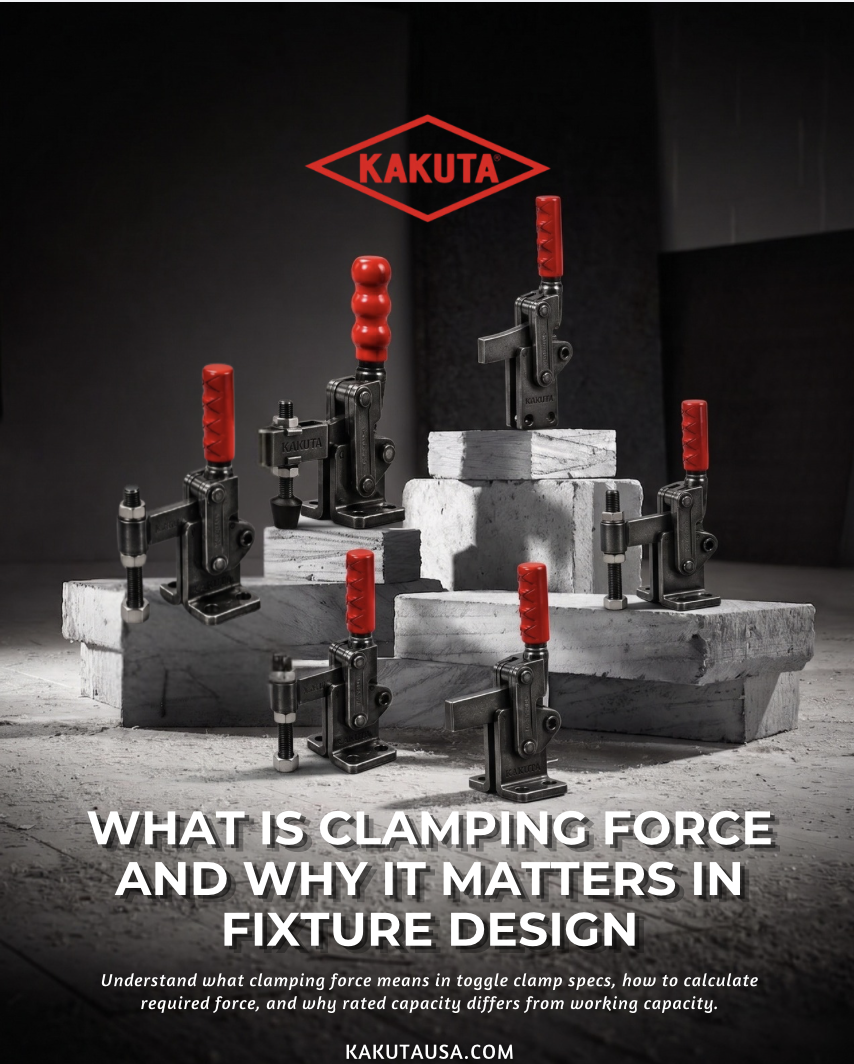
What Is Clamping Force and Why It Matters in Fixture Design

A clamp rated at 687 daN (700 Kg) doesn't guarantee that force at your workpiece — here's what the rating actually means, and how to size it correctly.

A clamp rated at 687 daN (700 Kg) doesn't guarantee that force at your workpiece. It guarantees that output under the test conditions printed on the spec sheet — straight-line force, full over-center engagement, no offset load. Mount that same clamp at an angle, skip the safety margin, or run it through 2,000 cycles a shift, and the number on the catalog page stops describing what's actually happening at the workpiece.

This is where most fixture problems start. Not from a clamp that's “wrong,” but from a clamp whose rated capacity was read as a working guarantee instead of a starting point.

This guide breaks down what clamping force actually measures, how to read a holding capacity rating correctly, how to calculate the force your application needs, and where engineers most often get the math — or the mounting — wrong.

Defining Clamping Force

Clamping force, also called hold-down force or holding force, is the amount of force a toggle clamp's arm exerts on a workpiece once the toggle mechanism is fully engaged. Kakuta — like most international manufacturers — publishes this figure in daN (decanewtons), the standard force unit used across European and international spec sheets.

That single number is meant to summarize a clamp's ability to resist cutting, drilling, welding, or assembly forces acting on the part. But it's a starting point for fixture design, not a complete answer. A published rating describes performance under defined test geometry — not the working capacity in every fixture it gets bolted into.

→ Explore the Kakuta HH Series

How to Read a Holding Capacity Rating (Rated vs. Actual)

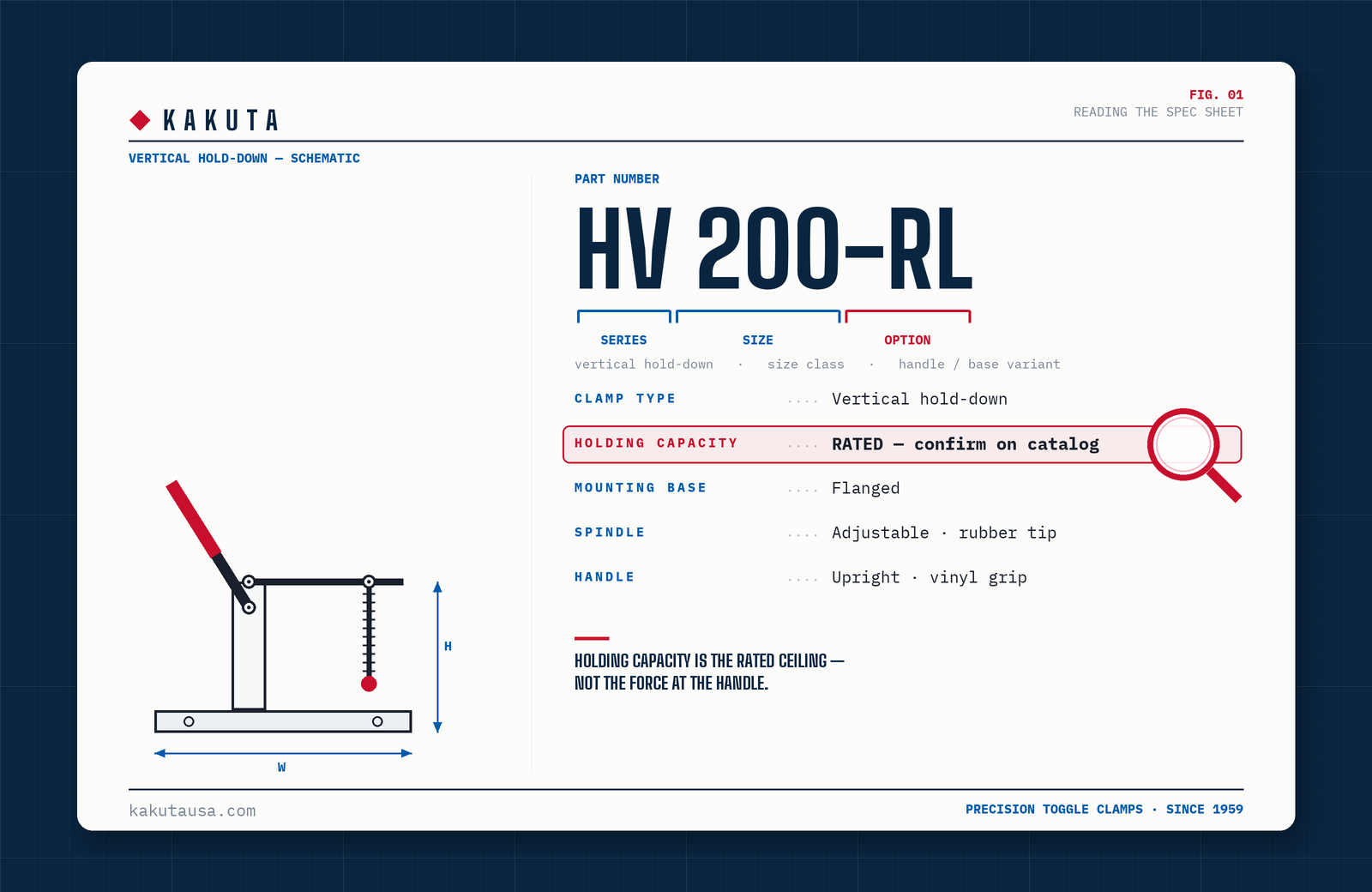
Every toggle clamp spec sheet lists a rated holding capacity: the maximum force the clamp produces when the toggle is fully over-center and the arm is aligned with the test geometry used to establish that figure.

Actual holding force in your fixture depends on three things:

  • Force direction. Ratings are typically established for force applied perpendicular to the clamp arm. Off-axis loading reduces effective holding force.
  • Arm and spindle position. Holding capacity assumes correct arm length and spindle adjustment. An improperly set spindle reduces clamping pressure even on a correctly rated clamp.
  • Safety factor. Most fixture designs apply a margin below rated capacity — commonly a 2:1 to 3:1 safety factor — to account for vibration, repeated cycling, and material variation.

European manufacturers commonly label this figure as nominal holding force (daN); some publish it under their own notation conventions rather than a universal symbol. The underlying measurement is the same one shown on Kakuta's spec sheets as rated holding capacity — Kakuta publishes ratings in daN across the catalog specifically so the numbers read directly against European-format spec sheets, without conversion or notation guesswork.

Calculating Required Force for Your Application

Before specifying a clamp, work backward from the application:

  1. Identify the maximum force acting against the part. Cutting force, drill thrust, weld distortion, and assembly pressure all count toward this number.
  2. Add your safety factor. A 2:1 to 3:1 margin above the calculated working force is standard practice for production fixtures — not a conservative extra, but the baseline.
  3. Confirm the clamp's rated capacity exceeds that total, not just matches it.
  4. Check force direction against your fixture geometry. A clamp rated for straight-line holding force performs differently in an angled or offset mounting.

A clamping force calculator can do the arithmetic. The engineering judgment is in steps 1 and 4 — knowing what's actually pulling, pushing, or vibrating against the part, and whether the clamp is mounted to resist it directly.

Common Clamping Force Mistakes

A few patterns show up repeatedly in fixture reviews:

  • Matching rated capacity to working load with no safety margin. This leaves no buffer for cycling fatigue or part-to-part variation.
  • Ignoring force direction. A clamp that performs well in straight-line testing can underperform mounted at an angle to the load.
  • Sizing for static load only. Vibration and repeated cycling — common in welding and CNC fixtures — demand more holding force than a one-time static hold.
  • Treating all daN ratings as equivalent. Toggle clamp capacity varies significantly across series. Holding force should be matched to the specific fixture, not assumed from a general “heavy-duty” label.

Most of these don't show up as a catastrophic failure. They show up as a clamp that loosens after a few hundred cycles, or a part that drifts 0.1mm out of tolerance on the parts nobody double-checked.

Kakuta Series: Force Ratings by Application

Kakuta's heavy-duty VH Long Life Series spans four confirmed holding-force tiers, each suited to a different production environment:

Model Rated Holding Force Typical Application
VH 100 / VH 101 294 daN (300 Kg) Entry-level heavy duty — workholding jigs and fixtures
VH 302 / VH 303 687 daN (700 Kg) Mid-range heavy duty — automotive fixture use
VH 502 / VH 503 1,177 daN (1,200 Kg) Industrial heavy load — high-cycle production
VH 601 / VH 602 2,354 daN (2,400 Kg) Maximum capacity — automotive and structural jigs

Holding force comparison across the Kakuta VH Long Life Series, 294–2,354 daN (300–2,400 Kg)

For lighter-duty applications, Kakuta's HH and HV series cover standard horizontal and vertical hold-down work where full VH-range capacity isn't required.

A note for engineers cross-referencing European spec sheets: the VH 100 through VH 602 range corresponds directly to the heavy-duty vertical series used by UK manufacturers under VA-series-style notation, and to what Italian suppliers list as Serie Verticale Pesante. Kakuta's catalogue ratings are published in Kg; daN equivalents are shown in the table above (1 Kg ≈ 0.981 daN), so the comparison against European daN-format spec sheets is a straightforward read, not a conversion exercise.

→ Explore the Kakuta VH Heavy-Duty Series

Conclusion

Clamping force is a useful spec, read correctly. Rated capacity tells you what a clamp produces under defined test conditions; actual performance in your fixture depends on direction, mounting, and safety margin. Whether you're comparing daN ratings against a European spec sheet or sizing a new fixture from scratch, start with the working force your application actually generates, build in a margin, and match it against confirmed holding capacity — not a general-duty label.

For the full breakdown of clamp types and how to match one to your fixture geometry, see our guide on how to choose the right toggle clamp.

Frequently Asked Questions

What is clamping force in a toggle clamp?

Clamping force, also called hold-down force or holding force, is the amount of force a toggle clamp exerts on a workpiece once the toggle mechanism is fully engaged. It's published in daN on most international and European-format spec sheets.

Why is rated holding capacity different from actual holding force?

Rated capacity is measured under defined test conditions — straight-line force, full over-center engagement. Actual force in your fixture depends on mounting angle, spindle adjustment, and the safety margin applied during design.

How much safety margin should I build into a clamping force calculation?

Most production fixtures apply a 2:1 to 3:1 safety factor above the calculated working force, to account for vibration, repeated cycling, and material variation.

Do Kakuta's force ratings compare directly to European toggle clamp specs?

Yes. Kakuta publishes holding force in daN, the same unit used across European spec sheets, including the conventions used by UK and Italian heavy-duty vertical clamp suppliers — so ratings can be compared directly without conversion.

🔩 Looking for the Right Toggle Clamp?

Browse KAKUTA USA's full range of Release-Lock Toggle Clamps — built for precision workholding in CNC, welding, and assembly.

Shop Toggle Clamps →
Read More
How to Choose the Right Toggle Clamp for Your Application
Engineering Guides Ajariya Wunseesang Engineering Guides Ajariya Wunseesang

How to Choose the Right Toggle Clamp for Your Application

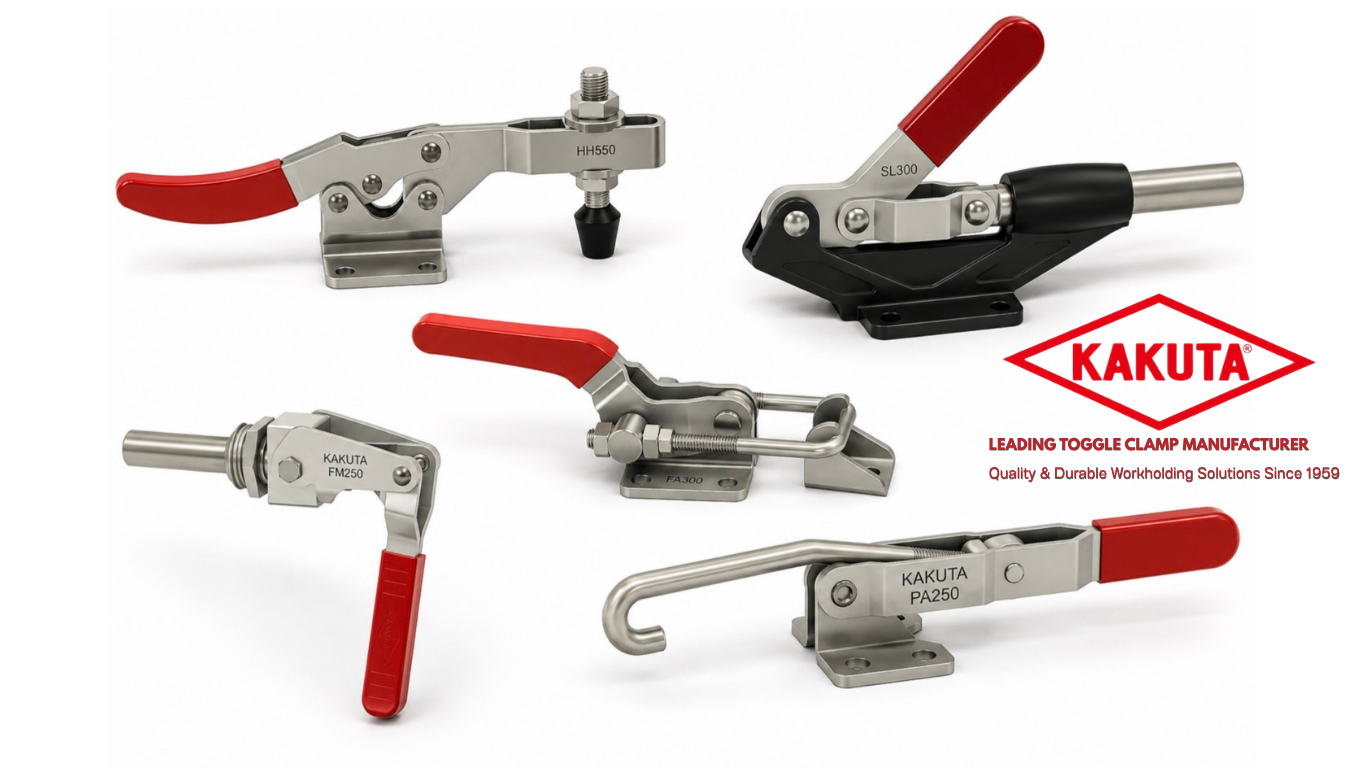
Kakuta toggle clamp types lineup — HH horizontal handle, HV vertical handle, FA straight-line action, SL latch action, AC air clamp, FM mini, and PA pneumatic toggle clamps for industrial workholding

Kakuta toggle clamp types lineup — HH horizontal handle, HV vertical handle, FA straight-line action, SL latch action, AC air clamp, FM mini, and PA pneumatic toggle clamps for industrial workholding

Kakuta toggle clamp types lineup — HH horizontal handle, HV vertical handle, FA straight-line action, SL latch action, AC air clamp, FM mini, and PA pneumatic toggle clamps for industrial workholding

Choosing the wrong toggle clamp does not announce itself immediately. The fixture closes. The part seats. Production begins. Then, three weeks later, a clamp fails mid-cycle, a part shifts during welding, or an operator compensates with a workaround that becomes a safety concern.

The right toggle clamp is not simply the one that fits the mounting footprint. It is the one that matches the direction of your clamping force, the geometry of your fixture, the cycle rate of your production line, and the environment your equipment works in.

This guide covers the seven main toggle clamp types available in the Kakuta range, the critical questions to answer before you specify, and how to match both to the series designed for your application.

What Is a Toggle Clamp?

A toggle clamp is a mechanical workholding component that uses over-center geometry to lock a workpiece in position. When the handle passes through the center point of the toggle linkage, the clamp achieves a self-locking state — holding the part securely without any continuous operator force applied.

This over-center locking principle is what distinguishes toggle clamps from simple mechanical clamps. Once locked, the clamp maintains holding force through the full machining, welding, or assembly cycle, releasing only when the operator deliberately opens the handle.

Toggle clamps are used across jig and fixture applications, assembly lines, welding fixtures, CNC machining setups, and quality inspection stations wherever a workpiece must be held in a precise, repeatable position.

Kakuta has been manufacturing precision toggle clamps since 1959. The product range spans standard, heavy-duty, latch-action, pneumatic, and compact models, covering holding capacities from light assembly applications to demanding automotive and structural jig environments.

Diagram showing toggle clamp over-center geometry — pivot point, clamping force direction, and locked position for industrial jig and fixture applications.

The 7 Main Toggle Clamp Types

Understanding the fundamental difference between clamp types is the first step in the selection process. Each type is optimised for a different force direction and fixture geometry.

Horizontal Handle Clamps (HH Series)

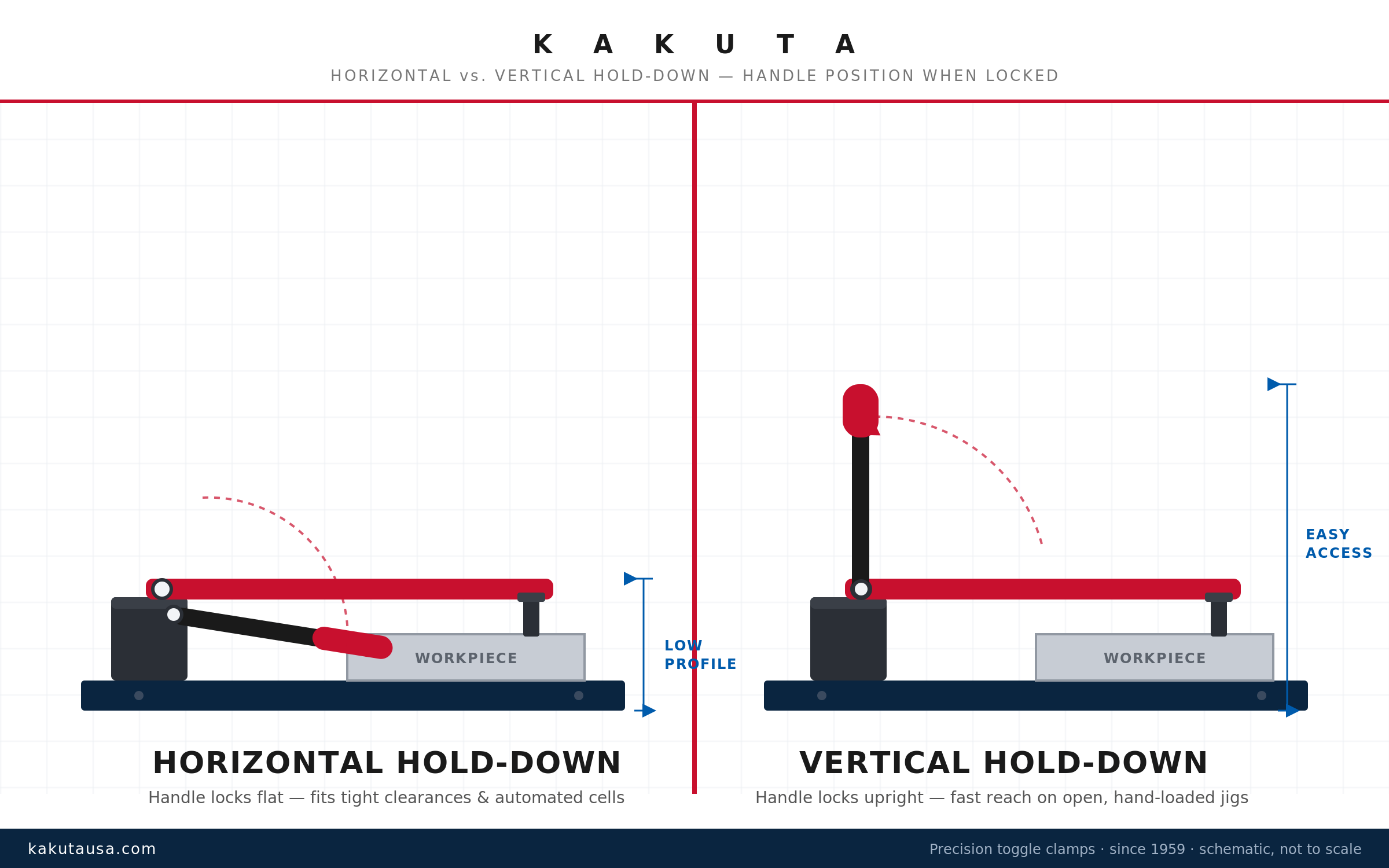
The horizontal handle clamp is the most widely used toggle clamp type in general manufacturing. The handle operates in a horizontal plane, and the clamping spindle applies a vertical, downward hold-down force onto the workpiece.

HH series clamps are suited to applications where the operator has clear horizontal access to the handle, and where the primary clamping force direction is downward — holding a part onto a fixture base or machine table. They perform well in high-frequency production environments and are available in a broad range of holding capacities.

Typical applications include CNC machining fixtures, general assembly jigs, and inspection fixtures where space allows horizontal handle travel.

→ Explore the Kakuta HH Series

Vertical Handle Clamps (HV Series)

The vertical handle clamp operates with a handle that moves in a vertical plane. The clamping spindle delivers a downward or angled force depending on the model configuration.

HV series clamps are preferred where fixture geometry limits horizontal access — for example, in nested or multi-clamp fixtures where handles must not interfere with each other or with the workpiece approach path. They are also common in applications where the operator position makes a vertical handle stroke more ergonomically efficient.

For heavy-duty applications requiring holding forces from 300 daN up to 2,400 daN, Kakuta's VH Series (heavy-duty vertical handle clamps) provides an extended capacity range suited to automotive jig fixtures, structural holding applications, and high-cycle production lines where standard-duty clamps are insufficient.

→ Explore the Kakuta HV Series

Straight-Line Action Clamps (FA Series)

The straight-line action clamp, also called a push-pull clamp, delivers force in a linear direction — directly along the axis of the spindle travel. Unlike horizontal or vertical handle clamps, the FA series applies force horizontally inward or outward rather than downward.

This makes straight-line action clamps the correct choice where the workpiece must be pushed against a locating stop, pulled into a nest, or clamped from the side rather than from above. The inline force delivery also makes FA series clamps easier to integrate into fixtures where overhead clearance is restricted.

Common applications include side-clamping in welding fixtures, inline locating jigs, and assembly stations where a part must be pushed positively to a datum before clamping.

→ Explore the Kakuta FA Series

Latch Action Clamps (SL Series)

The latch action clamp — Kakuta's SL series — operates with a side-entry handle and a horizontal plunger that drives directly into the fixture to lock the workpiece. The action is a firm, decisive push-and-lock motion, making it fast to operate and easy to build into tight fixture layouts where a conventional horizontal or vertical handle would create interference.

SL series clamps are particularly well suited to applications where the clamp must engage from the side of the workpiece rather than from above, and where quick, consistent locking and release are required. The compact body profile allows SL clamps to be positioned closely together in multi-clamp fixtures without handle collision.

Typical applications include assembly jigs, inspection fixtures, sheet metal holding applications, and any production environment where operator speed and clamp accessibility matter as much as holding force.

→ Explore the Kakuta SL Series

Air Clamps (AC Series)

Kakuta's AC series air clamps replace the manual handle with a pneumatic actuator, enabling automated clamping and unclamping as part of a machine cycle or PLC-controlled sequence. The pneumatic mechanism drives the same over-center toggle geometry used in manual clamps, delivering consistent holding force on every cycle without operator involvement.

AC series clamps are specified when cycle rate demands exceed practical manual operation, when the fixture is integrated into an automated production cell, or when operator ergonomics require removing the manual clamping step from the production cycle entirely. They are readily integrated into existing pneumatic circuits and machine control systems.

Common applications include robotic welding cells, automated assembly lines, high-volume CNC production fixtures, and any environment where repeatable, hands-free clamping is a production requirement.

→ Explore the Kakuta AC Series

Mini Toggle Clamps (FM Series)

The FM series covers Kakuta's compact and miniature toggle clamp range — precision workholding components engineered for applications where space is severely constrained and standard-size clamps cannot be accommodated without fixture redesign.

FM series clamps retain the same over-center locking geometry and reliable hold-down action as full-size Kakuta clamps, scaled down to a fraction of the footprint. They are used in small-part assembly fixtures, electronics manufacturing, optical component handling, laboratory equipment, and any application where the workpiece itself is small or where fixture density requires multiple clamps in a very limited area.

Despite their compact size, FM series clamps deliver consistent, repeatable holding force appropriate for precision light-duty and medium-duty applications.

→ Explore the Kakuta FM Series

Pneumatic Toggle Clamps (PA Series)

Kakuta's PA series pneumatic toggle clamps combine the mechanical over-center locking action of a manual toggle clamp with a pneumatic cylinder that drives the clamping arm automatically. Unlike the AC air clamp — which replaces the full toggle mechanism with a pneumatic actuator — the PA series retains the familiar toggle clamp body and adds pneumatic actuation to it, making the transition from manual to automated clamping straightforward in existing fixture designs.

PA series clamps are well suited to semi-automated and fully automated production environments where consistent clamping force and cycle-accurate repeatability are required. They are commonly used in welding fixtures, assembly automation, and production lines where a manual operator step needs to be eliminated without completely redesigning the fixture layout around a different clamp body.

Integration with a pneumatic circuit is direct, and the toggle mechanism's self-locking geometry provides a mechanical backup even under pressure fluctuations.

→ Explore the Kakuta PA Series

Seven Kakuta toggle clamp types comparison — HH, HV, FA, SL, AC, FM, and PA pneumatic toggle clamps for industrial workholding and jig fixture applications

5 Questions to Ask Before You Specify a Toggle Clamp

Once you know which clamp type fits your force direction and fixture geometry, these five questions will define the correct model within that type.

1. What direction is your primary clamping force? This is the first filter. Downward vertical force points to the HH or HV series. Horizontal inline force points to the FA or SL series. If clamping is automated and integrated into a machine cycle, evaluate the AC or PA series — AC for full actuator-based clamping, PA for pneumatic automation of a toggle clamp body. For small-part or compact fixture work, evaluate the FM series against the space constraints first. Getting the force direction wrong makes every other decision irrelevant.

2. What is the required holding capacity? Catalogue holding capacity is a rated maximum — not a working load. In practice, most fixture engineers apply a safety factor of 2:1 to 3:1 against the actual clamping force required by the application. For light assembly work, the FM mini series or standard HH or SL clamps are sufficient. For heavy jig applications, automotive fixtures, or structural workholding requiring 1,000 daN and above, Kakuta's VH heavy-duty series provides verified holding capacity up to 2,400 daN.

3. What is your part's geometry and surface condition? A flat, machined surface clamps differently from a curved or coated workpiece. Spindle tip selection — flat tip, neoprene tip, or swivel spindle — should match the workpiece contact geometry. Clamp arm height and reach must accommodate the workpiece profile without interference.

4. How many cycles per shift does your fixture run? A fixture running 200 cycles per shift operates differently from one running 2,000. Higher cycle rates accelerate wear on pivot pins, spindle threads, and handle mechanisms. For high-cycle environments, select models from Kakuta's range with appropriate structural ratings, or specify the PA or AC pneumatic series to remove manual wear from the equation and ensure consistent, repeatable clamping on every cycle.

5. Does the environment require corrosion resistance or special surface treatment? Standard production environments are served by Kakuta's standard surface finish. For wet machining environments, chemical exposure, or food and beverage applications, confirm the clamp finish and material specifications match the environmental requirements. Where European industrial standards are a reference, Kakuta's VH series corresponds directly to the VA series specifications used by UK and European fixture engineers.

Kakuta precision toggle clamps

Matching the right series to your application

Use this reference to identify the correct Kakuta clamp series based on your application type, holding force requirements, and fixture geometry.

Series Application Key consideration
HH Series General machining fixture, CNC setup Downward hold-down force with horizontal handle travel. Best where the operator has clear lateral access to the handle.

Most widely used toggle clamp type in general manufacturing

HV Series Multi-clamp fixture, limited lateral space Vertical handle travel in a compact footprint. Preferred where horizontal access is restricted by fixture geometry or operator position.

Well-suited to nested fixtures and ergonomic overhead clamping

VH Heavy-Duty Automotive jig, structural fixture High holding force from 300 – 2,400 daN. Built for high-cycle production lines where standard-duty clamps are insufficient.

Japanese precision equivalent to VA Series (UK/EU) and Serie Verticale Pesante (Italy)

FA Series Side-clamping, inline locating fixture Linear push-pull force along the spindle axis. The correct choice where overhead clearance is restricted or the part must be pushed to a datum.

Common in welding fixtures and side-clamping assembly stations

SL Series Fast side-entry latch, multi-clamp layout Latch action with compact body. Fast push-and-lock operation where handles must not interfere with adjacent clamps or workpiece approach.

Sheet metal holding, assembly jigs, dense multi-clamp fixtures

AC Series Automated production cell, robotic welding Full pneumatic actuation replaces the manual toggle mechanism for PLC-integrated, hands-free clamping on every cycle.

High-volume CNC fixtures and robotic cells requiring automated operation

FM Series Small-part fixture, compact or dense layout Miniature footprint with full over-center locking action. For fixtures where standard-size clamps cannot be accommodated.

Electronics, optical components, precision light-to-medium-duty assembly

PA Series Semi-automated fixture, toggle body + pneumatic drive Pneumatic actuation added to a standard toggle clamp body. Retains over-center mechanical backup under pneumatic pressure fluctuation.

Welding fixtures and assembly automation transitioning from manual clamping

Kakuta toggle clamp mounted on industrial jig fixture holding a metal workpiece — precision workholding in manufacturing application

A Note on Heavy-Duty Applications and European Equivalents

For engineers currently specifying heavy-duty vertical toggle clamps from European sources — including VA series clamps from UK manufacturers or the Serie Verticale Pesante from Italian suppliers — Kakuta's VH series provides directly equivalent holding capacities and a comparable product range.

The VH 100 through VH 602 series spans 300 daN to 2,400 daN nominal holding force, covering the same capacity range as the heavy-duty vertical series available from European manufacturers, with Japanese precision engineering and global distribution from the USA platform.

For engineers transitioning from another brand or cross-referencing a current specification, Kakuta's technical team can assist with direct model equivalency confirmation.

→ Contact Kakuta USA for a cross-reference

Conclusion

Selecting the right toggle clamp comes down to four variables: force direction, holding capacity, cycle rate, and environment. The clamp type — HH, HV, FA, SL, AC, FM, or PA — follows from the force direction and fixture geometry. The series and model follow from the remaining variables.

Kakuta's product range has been engineered since 1959 to cover every standard workholding application, from compact FM mini clamps for small-part fixtures to heavy industrial VH jigs requiring over 2,000 daN of holding force. The selection framework above applies regardless of the industry or scale of production.

If your application falls outside standard parameters — unusual fixture geometry, extreme cycle rates, or heavy-load structural holding — contact Kakuta USA directly. The right clamp specification is worth the conversation.

→ Explore the full Kakuta toggle clamp catalog   → Contact Kakuta USA for technical support

Kakuta has been manufacturing precision toggle clamps since 1959. Products are available through authorized distributors across North America and globally. For specification support, contact Kakuta USA.

Read More