

The spec sheet already tells you which clamp to buy — if you know how to read it. Here's how to decode holding capacity, handle type, and a Kakuta part number so you order the right hold-down the first time.
Every wrong clamp on a receiving dock started as a right-looking line on a purchase order. Toggle clamp catalogs pack a lot into a small table — holding capacity, handle orientation, mounting base, spindle style — and most of it is also encoded in the part number itself. Learn to read both and you stop guessing: you can look at a spec sheet, match it to your fixture, and order with confidence instead of a follow-up phone call.
This guide breaks a toggle clamp spec sheet into its core fields, explains what holding capacity actually describes, and shows how a Kakuta part number is structured so the code tells you what you're buying.
The Fields That Actually Decide Your Order
A toggle clamp spec sheet can list a dozen values, but a handful do the real work of narrowing a selection. Read these first:
| Spec field | What it tells you | Why it matters |
|---|---|---|
| Clamp type | Horizontal, vertical, push-pull/straight-line, or latch action | Sets how the handle moves and where force is applied — the fit question comes first |
| Holding capacity | The maximum clamping load the clamp is rated to hold | Must exceed the forces trying to move your part, with margin to spare |
| Mounting base | Hole pattern, footprint, and orientation of the base plate | Determines whether the clamp bolts cleanly to your fixture |
| Spindle / clamping bolt | The adjustable pressure screw — length, thread, and tip style | Sets how the clamp contacts the part and how much height it adjusts for |
| Handle style | Handle shape and grip, and the locked-position profile | Affects operator access and clearance above the fixture |
Notice the order: type and holding capacity narrow the field, then mounting and spindle confirm the clamp physically fits and contacts the part correctly. Get those five right and the rest of the sheet is refinement.
Holding Capacity Is Not Hand Force
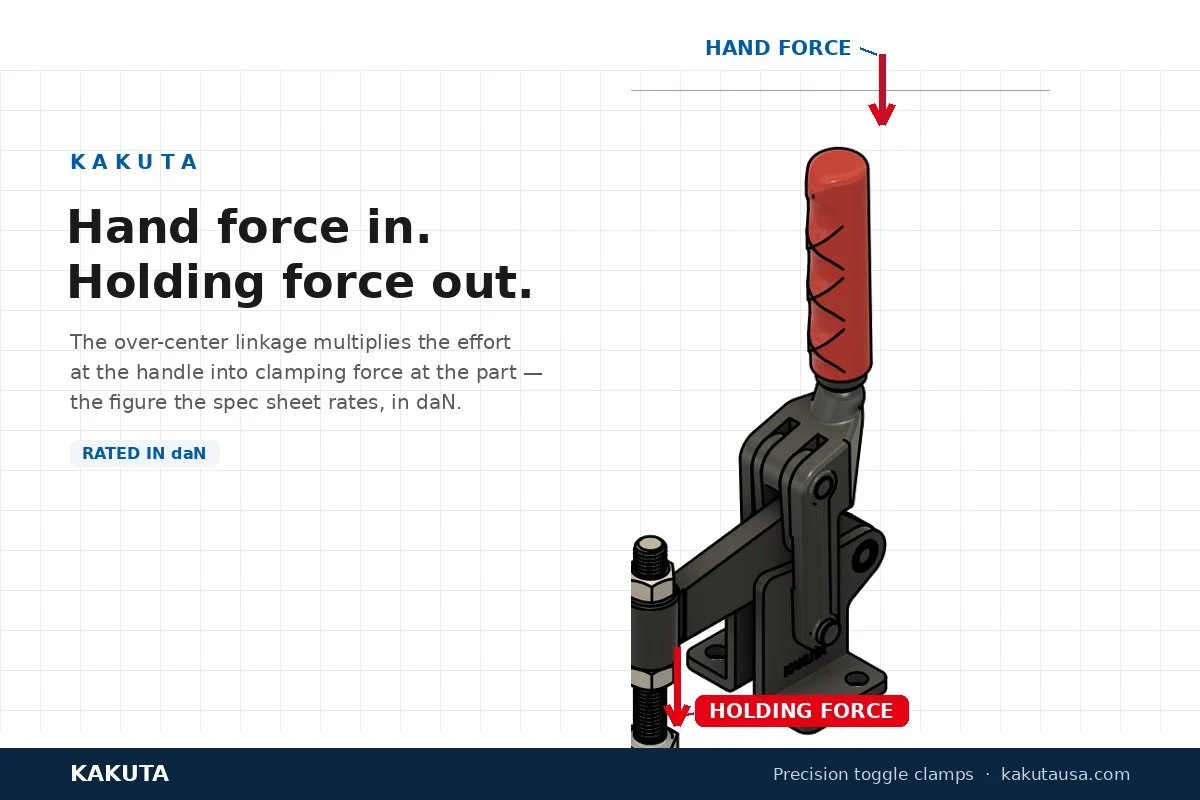
The single most misread number on a spec sheet is holding capacity. Holding capacity is the maximum load the locked clamp is rated to resist — the force trying to lift or shift the part while the clamp holds it down. It is not the effort you apply at the handle, and it is not a target to clamp to. It's a ceiling: stay under it, with margin.
Rule of thumb: your holding capacity should comfortably exceed the worst-case force trying to move the workpiece — not just equal it. Sizing the clamp right to the edge leaves nothing for cutting forces, vibration, or an off-center load.
That distinction is exactly why two clamps with the same holding-capacity rating can still be the wrong and right pick for one fixture — because handle geometry, base, and spindle differ. Holding capacity tells you a clamp is strong enough; it never tells you the clamp fits. For a fuller treatment of sizing the load, see our guide on how to choose the right clamping force.
How to Read a Kakuta Part Number
A part number isn't a random SKU — it's a compressed spec sheet. Read left to right, a Kakuta toggle clamp code generally moves from the broad to the specific: a series prefix that identifies the clamp family, a size or capacity number, and an optional suffix for a variant or configuration.
1. The series prefix — what kind of clamp
The leading letters tell you the clamp family, which maps directly to how it mounts and holds:
- HH — Horizontal Hold-down. Handle locks flat and low; used where vertical clearance is tight or tooling passes over the fixture. See the HH range →
- HV — Vertical Hold-down. Handle locks upright; used on open-top fixtures where fast, ergonomic access matters. See the HV range →
- SL — Straight-line / push-pull. Plunger action that locks along a line rather than pivoting down — for linear holding and drawing parts together. See the SL range →
- FA — Flanged-base action clamp. A hold-down family identified in the current range for general fixturing. Browse all clamps →
Read the prefix first and you already know the clamp's motion and roughly where it belongs — before you look at a single dimension.
2. The size number — where it sits in the family
The number that follows the prefix indicates the clamp's size class within its series — larger numbers denote larger, higher-capacity models in that family. So an HH 350 sits above an HH 300 in the horizontal line, and an HV 300 above an HV 250 in the vertical line. The number ranks models within a series; always confirm the exact rated holding capacity against the spec sheet rather than assuming a value from the number alone.
3. The suffix — the specific configuration
A trailing letter or code (for example, the -RL on an HV 200-RL) flags a variant — a specific handle, base, spindle, or option within that size. When two line items share a series and size but end differently, the suffix is where they diverge; match it exactly to the configuration your fixture needs.
Read it like a sentence: HV 200-RL = vertical hold-down (HV), 200 size class, RL configuration. Series → size → option, every time.
A Quick Reading Framework
Put it together and reading any toggle clamp spec sheet or part number comes down to four passes:
- Type. Read the series prefix (HH, HV, SL, FA) to confirm the clamp motion fits your fixture and clearance.
- Capacity. Check the holding-capacity rating exceeds your worst-case part-moving force, with margin.
- Fit. Verify the mounting base pattern and spindle style match how the clamp bolts down and contacts the part.
- Configuration. Match the size number and any suffix exactly, so the variant you order is the one you need.
Run those four passes and the spec sheet stops being a wall of numbers — it becomes a checklist that confirms the clamp before it ships.
Common Mistakes When Reading a Spec Sheet
- Treating holding capacity as a target. It's a rated ceiling to stay under with margin, not a number to clamp up to.
- Ordering by size number alone. The number ranks models within a series; it isn't a universal capacity value across families. Confirm the rating.
- Dropping the suffix. Omitting a variant code like -RL can send you a different handle, base, or spindle than the fixture was designed around.
- Skipping the mounting base. A clamp can be the right type and capacity and still not bolt to your plate. Check the base pattern every time.
Conclusion
A toggle clamp spec sheet is a decision tool, not a data dump. Read the clamp type and holding capacity to narrow the field, confirm the mounting base and spindle to prove it fits, and match the part number — series, size, suffix — to lock in the exact configuration. The part number is the spec sheet in shorthand: once you can read HV 200-RL at a glance, you order the right hold-down the first time. Still deciding between clamp types? Start with our guide on horizontal vs. vertical toggle clamps.
Frequently Asked Questions
What does holding capacity mean on a toggle clamp spec sheet?
Holding capacity is the maximum clamping load the locked clamp is rated to resist — the force trying to lift or move the workpiece while it's held. It is not the effort you apply at the handle. Choose a clamp whose holding capacity comfortably exceeds your worst-case part-moving force, with margin for cutting loads and vibration.
How do I read a Kakuta toggle clamp part number?
Read left to right: a series prefix identifies the clamp family (HH horizontal, HV vertical, SL straight-line/push-pull, FA flanged-base), a size number ranks the model within that family, and an optional suffix (such as -RL) flags a specific configuration. For example, HV 200-RL is a vertical hold-down, 200 size class, RL variant.
Does a higher part number mean a stronger clamp?
A higher size number generally means a larger, higher-capacity model within the same series — but the number ranks models inside a family, not across families. Always confirm the exact rated holding capacity on the spec sheet rather than assuming a value from the number alone.
Which spec fields matter most when choosing a toggle clamp?
Start with clamp type and holding capacity to narrow the selection, then confirm the mounting base and spindle style to make sure the clamp physically fits your fixture and contacts the part correctly. Handle style and the exact part-number configuration finalize the choice.
