

Toggle Clamp Maintenance: How to Inspect, Adjust & Keep Hold-Downs Holding
A toggle clamp is a simple mechanism, which is exactly why it gets ignored until it slips. A few minutes of routine maintenance keeps holding force repeatable, protects your tolerances, and adds years to every clamp on the fixture.
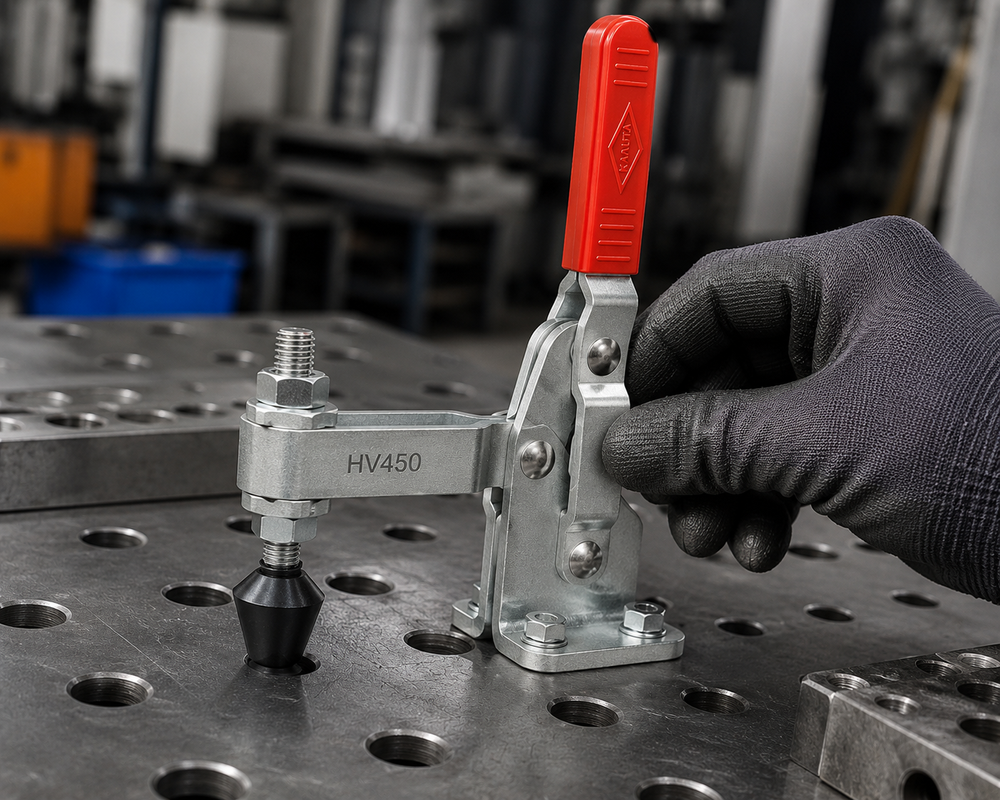
A toggle clamp earns its keep by doing the same thing thousands of times: swing over-center, lock, hold. That repetition is the whole point — and it's also what slowly wears pins, loosens spindles, and lets grit build up in the linkage. None of it happens overnight, so the clamp keeps working right up until the day a part shifts mid-cut and you're chasing a scrap report instead of a maintenance log.
The good news: toggle clamps reward the lightest maintenance program you can imagine. This guide covers what to inspect and how often, how to adjust holding force safely, what to lubricate (and what to leave dry), and how to troubleshoot the handful of problems that account for nearly every clamp that stops holding true.
Why Toggle Clamps Drift Out of Spec
Nothing about a clamp fails dramatically — it drifts. Knowing the failure modes tells you exactly what to look at:
- Pivot wear. Every cycle loads the pins and bushings in the linkage. Over thousands of cycles the holes elongate slightly, adding play that shows up as a clamp that no longer locks with the same crisp over-center snap.
- Spindle loosening. Vibration and repeated contact can back off the clamping bolt (spindle) or its lock nut, quietly reducing the pressure the clamp applies to the part.
- Contamination. Chips, coolant residue, weld spatter, and shop dust pack into the joint, stiffening the action and accelerating pin wear.
- Handle and grip fatigue. A loose or cracked handle grip changes operator feel and can mask how much force is actually being applied.
- Base and mounting movement. If the clamp's mounting bolts creep loose, the whole clamp moves — and no amount of clamp health fixes a base that shifts.
Read that list and a maintenance routine writes itself: check the pins, the spindle, the joint cleanliness, the handle, and the mounting. Five things.
A Simple Toggle Clamp Maintenance Routine
You don't need a formal program — you need a rhythm. Match the interval to how hard the clamp works and the environment it works in (welding and casting shops contaminate faster than clean assembly cells).
| Interval | Task | What you're checking for |
|---|---|---|
| Each shift / setup | Quick feel-and-look: cycle the handle, eyeball the joint | Loss of the crisp over-center lock, visible chips or spatter, an obviously loose spindle or handle |
| Weekly | Wipe down, clear the linkage, confirm mounting bolts are tight | Built-up grit, stiffening action, mounting bolts backing off |
| Periodic (monthly / by cycle count) | Inspect pins and bushings for play, verify holding force, light lube | Elongated pivots, reduced clamping pressure, dry or squeaking joints |
Log it once, thank yourself later. A one-line note per periodic check — date, clamp, anything adjusted — turns "why do parts keep shifting on Fixture 3?" into a pattern you can actually see.
The ten-second per-shift check
Engage the clamp with no part in it and feel the action. A healthy toggle clamp snaps firmly past over-center and locks with no lateral wobble at the handle. If it feels mushy, notchy, or you can rock the handle side to side, flag it for the periodic inspection. Glance at the joint for chips and at the spindle and mounting bolts for anything visibly loose. That's it.
How to Adjust Holding Force Safely
On most hold-down clamps, holding pressure is set by the spindle — the adjustable clamping bolt that contacts the part. Thread it in to increase contact pressure and clamping force; back it out to decrease it. After setting, tighten the spindle's lock nut so vibration can't change what you dialed in.
The one rule that matters: never adjust past the clamp's rated holding capacity. The spindle sets contact pressure, but the clamp's linkage is only rated to a published holding load. Cranking the spindle to "extra tight" doesn't make the clamp stronger — it over-stresses the mechanism, accelerates pin wear, and can distort the workpiece. Set enough force to hold the part against its worst-case load with margin, and stop there. If you're not sure what that number should be, our guide on how to choose the right clamping force walks through the math, and the spec sheet reading guide → shows where to find the rated capacity.
Set by feel, confirm by spec: adjust the spindle to a firm, repeatable hold, then check that you're comfortably under the clamp's rated holding capacity — never at or above it.
Lubrication: What to Oil, What to Leave Alone
Toggle clamps need very little lubrication, and over-oiling causes its own problem: oil is a magnet for chips and grit, which turns into grinding paste in the joint. Keep it minimal and targeted.
- Lubricate the pivot points. A light machine oil on the pins and moving linkage joints keeps the action smooth and reduces wear. A single drop per pivot, worked through by cycling the handle, is plenty.
- Keep the spindle threads clean and lightly oiled so adjustment stays smooth and the lock nut seats properly.
- Wipe off the excess. Any oil sitting on outer surfaces will collect debris — remove it after lubricating.
- Leave the clamping contact surfaces dry. Oil where the spindle tip or clamp arm meets the part can let the workpiece slip. Grip depends on a clean, dry contact.
In heavy-contamination environments (welding, grinding, casting), clean before you lubricate — adding oil over packed grit just seals it in.
Troubleshooting Common Toggle Clamp Problems
Almost every "the clamp won't hold" call traces back to one of these. Match the symptom, check the cause, apply the fix:
| Symptom | Likely cause | Fix |
|---|---|---|
| Clamp won't stay locked | Worn pivot pins, or spindle set so the clamp isn't reaching over-center | Check pins for play; reset spindle so the handle travels fully past over-center and locks |
| Holding force feels weak | Spindle backed off, or lock nut loose | Re-set the spindle to the correct pressure and tighten the lock nut — stay under rated capacity |
| Stiff or notchy action | Contamination in the linkage, or dry pivots | Clean the joint, then apply a drop of light oil to each pivot and cycle |
| Excess play / wobble at the handle | Elongated pin holes or worn bushings from high cycle count | Inspect the linkage; if pins are worn beyond light play, plan to replace the clamp |
| Part slips even when locked | Oil on the contact surface, wrong spindle tip, or under-sized clamp for the load | Clean the contact dry; confirm the spindle tip suits the part; verify holding capacity vs. the job |
| Clamp body shifts on the fixture | Loose mounting bolts | Re-torque the mounting hardware; add thread locker where appropriate |
When to Clean Up vs. When to Replace
Cleaning, lubricating, and re-setting the spindle solve the large majority of issues. Replacement is the right call when wear is in the linkage itself: if the pivot holes have elongated enough that the handle wobbles and the clamp no longer snaps cleanly over-center, no amount of cleaning restores repeatable holding. On a production fixture where every clamp needs to load the same way every cycle, a worn clamp is cheaper to swap than to babysit. Match the replacement exactly — series, size, and any configuration suffix — so the new clamp drops into the same base and holds the same way.
Conclusion
Toggle clamp maintenance isn't a project — it's a habit measured in seconds. Cycle the handle and feel for a crisp lock, keep the linkage clean, oil the pivots lightly and the contact surface never, set holding force to a firm hold that stays under the rated capacity, and keep the mounting bolts tight. Do that and your clamps hold the same way on cycle ten thousand as they did on cycle one — which is the entire reason you put a toggle clamp on the fixture in the first place.
Frequently Asked Questions
How often should I maintain a toggle clamp?
Give each clamp a ten-second feel-and-look every shift or setup, a wipe-down and mounting-bolt check weekly, and a fuller inspection — pins, holding force, light lubrication — periodically based on cycle count and environment. Clamps in welding, grinding, or casting areas need cleaning more often because they contaminate faster.
How do I adjust the holding force on a toggle clamp?
Adjust the spindle (the clamping bolt that contacts the part): thread it in for more clamping pressure, out for less, then tighten the lock nut so vibration can't change the setting. Always stay comfortably below the clamp's rated holding capacity — over-tightening over-stresses the linkage and can distort the part rather than holding it better.
What should I use to lubricate a toggle clamp?
A light machine oil on the pivot pins and linkage joints is all most clamps need — a single drop per pivot, cycled through, then wipe off the excess. Keep the spindle threads clean and lightly oiled. Leave the clamping contact surface dry, since oil there can let the workpiece slip.
When should I replace a toggle clamp instead of servicing it?
Replace it when wear is in the linkage itself — elongated pivot holes or worn bushings that leave the handle wobbling and the clamp unable to snap cleanly over-center. Cleaning and adjustment can't restore a worn mechanism, and on production fixtures a worn clamp that no longer holds repeatably is cheaper to swap than to work around. Match the replacement's series, size, and configuration exactly.
Clamps that hold shift after shift
Browse KAKUTA USA's horizontal, vertical, and push-pull toggle clamps — precision hold-downs engineered for repeatable holding, ready to ship from Valencia, CA.
See the full range →