

How Do Toggle Clamps Work? The Over-Center Mechanism
How Do Toggle Clamps Work? The Over-Center Mechanism, Explained
A toggle clamp holds with a firm snap and stays locked without you touching it — no power, no ratchet, no constant hand pressure. That behavior comes from one clever piece of geometry called the over-center linkage. Understand it, and every choice you make about clamps gets easier.
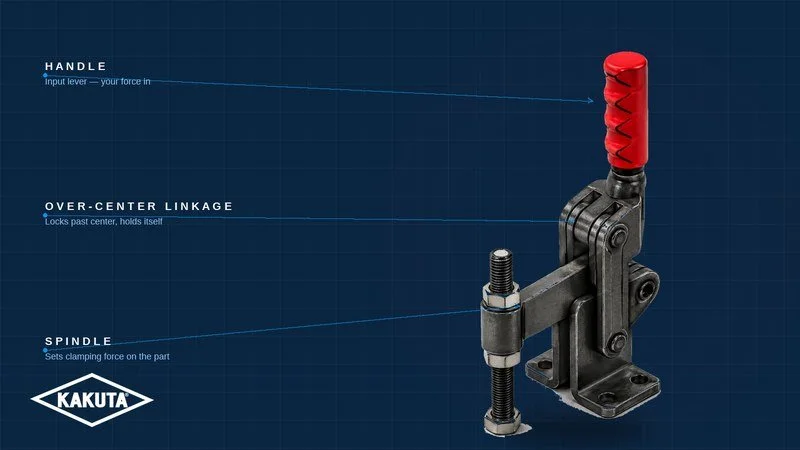
Toggle clamps are everywhere in a working shop — on welding tables, CNC fixtures, drill jigs, assembly stations, woodworking setups — and they all do the same job: hold a part firmly in the same place, every cycle, and release it fast. What makes them different from a simple screw clamp or a bar clamp is how they hold. Flip the handle and the clamp doesn't just apply pressure; it locks itself and stays locked until you flip it back. This guide explains exactly why that happens, what the parts do, and how the mechanism shapes the way you spec and use a clamp.
What a Toggle Clamp Is
A toggle clamp is a hand-operated hold-down device that uses a linked lever system to convert a small motion at the handle into a strong, self-locking clamping force at the workpiece. "Toggle" refers to the pivoting linkage — a set of pinned levers that move together — not to any switch or electronics. There's nothing to power and nothing to hold down manually once it's engaged.
Most toggle clamps share the same core anatomy, whatever their shape:
- Handle (operating lever). The arm you push or pull. It's your input, and its length is part of where the clamp's leverage comes from.
- Linkage and pivot pins. Two or more levers joined by pins that swing together. This is the "toggle" — the part that creates the over-center action.
- Clamping arm or plunger. The output that actually presses on the part (a hold-down bar on hold-down clamps, a sliding rod on straight-line push-pull clamps).
- Spindle. The adjustable clamping bolt, usually with a rubber or steel tip, that sets exactly where and how hard the clamp contacts the workpiece.
- Base. The mounting plate that bolts the clamp to your fixture so the whole assembly stays put.
If those part names sound familiar, it's because they're the same ones printed on a datasheet. Our guide to reading a toggle clamp spec sheet → walks through how each one shows up in the numbers.
The Over-Center Mechanism: Where the "Lock" Comes From
Here's the heart of it. As you move the handle toward the clamped position, the pivot pins in the linkage line up along a nearly straight path. At one exact point the center pivot passes through the line connecting the two outer pivots — that's the "center." The clamp reaches maximum tension right at that instant, then the handle travels just slightly past it and settles against a stop.
That tiny bit of over-travel is the whole trick. Once the pivot is over center, any force from the workpiece pushing back on the clamp tries to rotate the linkage further into the stop rather than back toward release. In other words, the load itself holds the clamp closed. The mechanism is now in a stable, locked state and will stay there with zero effort from you until you deliberately pull the handle back through center to release it.
The snap you feel is the physics working. That firm click as the handle seats is the linkage crossing over center and dropping into its locked position. A clamp that has lost that crisp snap is telling you something — usually worn pivots. That's why the maintenance routine → starts with feeling for a clean over-center lock.
Mechanical Advantage: Small Hand, Big Hold
The over-center geometry explains the lock. Leverage explains the force. A toggle clamp is a system of levers, and like any lever it multiplies your input. A modest push on a relatively long handle becomes a much larger clamping force at the spindle, because the linkage trades distance for force — your hand moves a long way while the clamping arm moves a short way under high pressure.
The multiplication isn't constant through the stroke. As the linkage approaches center, mechanical advantage climbs steeply — which is exactly why holding force peaks near the over-center point and why the last few degrees of handle travel feel firm. This is also why "holding capacity" on a spec sheet is a specific rated number, not just "as hard as you can push." The clamp is engineered to deliver a designed force and to lock, not to be cranked past its rating. If you want the full picture of how much force you actually need, our guide on choosing the right clamping force → covers matching force to the job with a safe margin.
Holding Capacity vs. Clamping Force
Because the mechanism is doing two different things — locking and pressing — two numbers matter, and they're easy to confuse:
- Holding capacity is the maximum load the locked linkage is rated to resist without opening or being damaged. It's a property of the clamp's mechanism and size.
- Clamping force is how hard the spindle presses on your particular part, which you set by adjusting the spindle. You choose this for the job, staying comfortably under the holding capacity.
The over-center design is what lets a clamp hold its full rated capacity with no ongoing input from you. But it also means over-tightening the spindle doesn't buy you a stronger clamp — it just over-stresses the same linkage. Set enough force to hold the part against its worst-case load, then stop.
How the Mechanism Changes by Clamp Type
Every toggle clamp uses the over-center principle, but the linkage is arranged differently depending on which direction the force needs to go. That arrangement is what defines the main families:
| Type | How the mechanism is arranged | Best for |
|---|---|---|
| Vertical hold-down | Handle locks in the upright position; hold-down arm presses straight down onto the part | General fixturing where you need clearance above and easy handle access |
| Horizontal hold-down | Handle locks flat, low over the base; arm holds down in a low-profile envelope | Tight-clearance fixtures, automated cells, jigs under machine travel |
| Straight-line (push-pull) | Linkage drives a plunger in and out along one axis instead of pivoting an arm | Linear holding, latching, drawing two parts together along a line |
| Latch (pull-action) | Over-center hook or U-bar draws two surfaces tight and latches them | Doors, panels, mold halves, lids and enclosures that must pull closed |
Same physics, different geometry — and the geometry is what you actually choose between. If you're deciding which way the clamp should hold, the horizontal vs. vertical guide → breaks down clearance, access, and application in detail. You can also browse the ranges directly: vertical hold-down clamps, horizontal hold-down clamps, and straight-line push-pull clamps.
Why Engineers Choose the Over-Center Design
Once you see how the mechanism works, its advantages on the shop floor make sense:
- Self-locking. The part stays held with no clamping effort and no power — the geometry does the holding.
- Fast and repeatable. One handle motion clamps or releases in a fraction of a second, and it locks to the same position every cycle, which protects your tolerances.
- Positive, obvious state. Locked or open is unmistakable — you feel and see it, so operators aren't guessing whether the part is secured.
- High force from low effort. Leverage turns a light hand push into a strong, consistent hold.
- Simple and durable. Few moving parts, nothing to power, and easy to keep running with basic maintenance.
Conclusion
A toggle clamp works because of one elegant idea: a linkage that crosses slightly past center and locks itself, using the workpiece's own reaction force to stay closed. Leverage supplies the clamping force; the over-center point supplies the lock; the spindle lets you tune exactly how hard it presses. Everything else — vertical, horizontal, push-pull, latch — is that same mechanism packaged for a direction of hold. Knowing this is what turns clamp selection from guesswork into a decision: pick the geometry for your fixture, size the force for your part, and let the physics hold the line.
Frequently Asked Questions
How does a toggle clamp lock in place?
It uses an over-center linkage. As you move the handle to clamp, the pivot pins pass through a nearly straight line and settle just past that "center" against a stop. Once over center, any push-back from the workpiece drives the linkage further into the stop instead of toward release, so the clamp holds itself locked with no ongoing effort until you pull the handle back through center.
What does "over-center" mean on a toggle clamp?
Over-center describes the moment the linkage's center pivot moves just past the line connecting its two outer pivots. Clamping tension peaks at that center point, and the small amount of travel beyond it is what creates the stable, self-locking hold. It's the reason a toggle clamp snaps firmly closed and stays closed.
Do toggle clamps need electricity or air to hold?
No. A standard manual toggle clamp is purely mechanical — it holds through geometry and leverage, with no power required. (Pneumatic toggle clamps exist for automation, but they apply the same over-center principle using an air cylinder instead of a hand on the handle.)
What's the difference between holding capacity and clamping force?
Holding capacity is the maximum load the locked clamp is rated to resist — a fixed property of the clamp's mechanism and size. Clamping force is how hard the spindle presses on your specific part, which you set by adjusting the spindle. Choose clamping force for the job and keep it comfortably below the rated holding capacity.
The right mechanism for your fixture
Browse KAKUTA USA's vertical, horizontal, and straight-line push-pull toggle clamps — precision over-center hold-downs engineered for repeatable holding, ready to ship from Valencia, CA.
See the full range →🔩 Looking for the Right Toggle Clamp?
Browse KAKUTA USA's full range of Release-Lock Toggle Clamps — built for precision workholding in CNC, welding, and assembly.
Shop Toggle Clamps →