

How to Choose the Right Toggle Clamp for Your Application
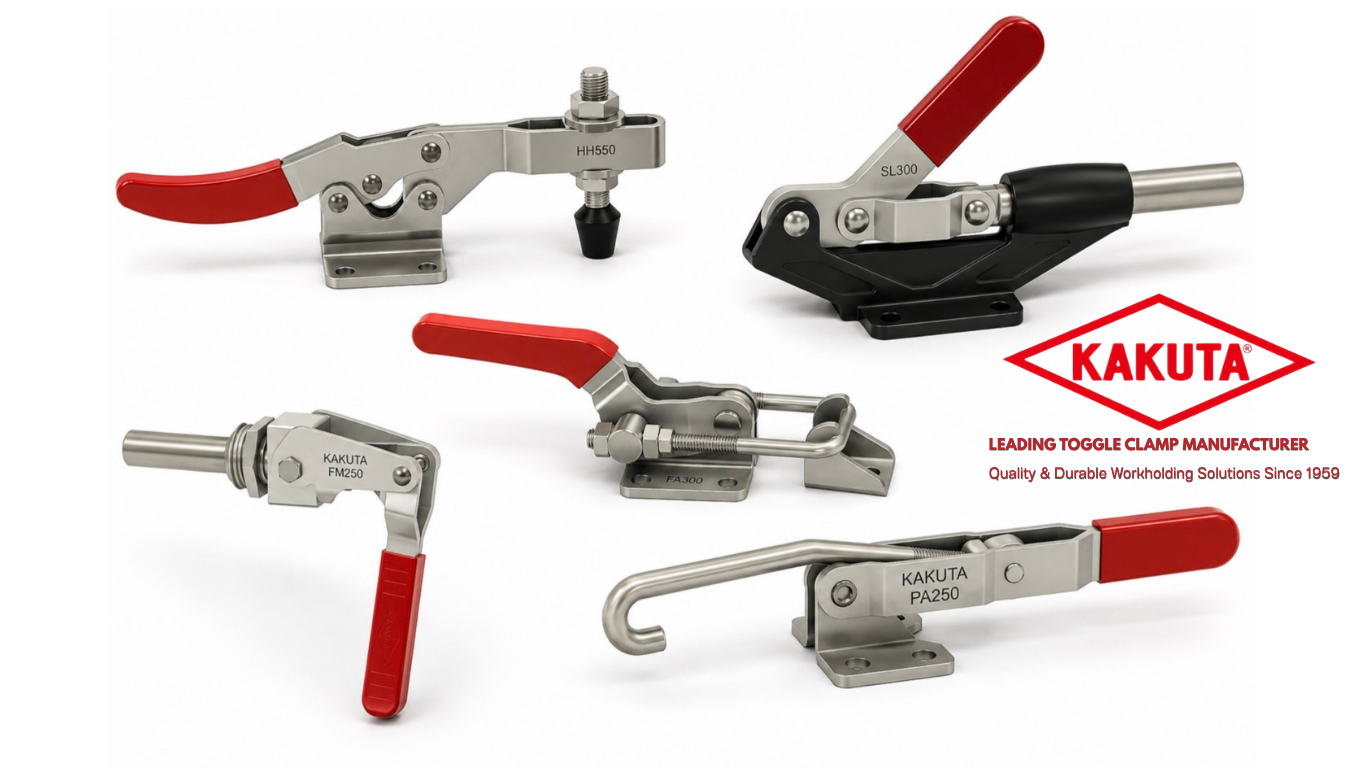
Kakuta toggle clamp types lineup — HH horizontal handle, HV vertical handle, FA straight-line action, SL latch action, AC air clamp, FM mini, and PA pneumatic toggle clamps for industrial workholding
Choosing the wrong toggle clamp does not announce itself immediately. The fixture closes. The part seats. Production begins. Then, three weeks later, a clamp fails mid-cycle, a part shifts during welding, or an operator compensates with a workaround that becomes a safety concern.
The right toggle clamp is not simply the one that fits the mounting footprint. It is the one that matches the direction of your clamping force, the geometry of your fixture, the cycle rate of your production line, and the environment your equipment works in.
This guide covers the seven main toggle clamp types available in the Kakuta range, the critical questions to answer before you specify, and how to match both to the series designed for your application.
What Is a Toggle Clamp?
A toggle clamp is a mechanical workholding component that uses over-center geometry to lock a workpiece in position. When the handle passes through the center point of the toggle linkage, the clamp achieves a self-locking state — holding the part securely without any continuous operator force applied.
This over-center locking principle is what distinguishes toggle clamps from simple mechanical clamps. Once locked, the clamp maintains holding force through the full machining, welding, or assembly cycle, releasing only when the operator deliberately opens the handle.
Toggle clamps are used across jig and fixture applications, assembly lines, welding fixtures, CNC machining setups, and quality inspection stations wherever a workpiece must be held in a precise, repeatable position.
Kakuta has been manufacturing precision toggle clamps since 1959. The product range spans standard, heavy-duty, latch-action, pneumatic, and compact models, covering holding capacities from light assembly applications to demanding automotive and structural jig environments.
Diagram showing toggle clamp over-center geometry — pivot point, clamping force direction, and locked position for industrial jig and fixture applications.
The 7 Main Toggle Clamp Types
Understanding the fundamental difference between clamp types is the first step in the selection process. Each type is optimised for a different force direction and fixture geometry.
Horizontal Handle Clamps (HH Series)
The horizontal handle clamp is the most widely used toggle clamp type in general manufacturing. The handle operates in a horizontal plane, and the clamping spindle applies a vertical, downward hold-down force onto the workpiece.
HH series clamps are suited to applications where the operator has clear horizontal access to the handle, and where the primary clamping force direction is downward — holding a part onto a fixture base or machine table. They perform well in high-frequency production environments and are available in a broad range of holding capacities.
Typical applications include CNC machining fixtures, general assembly jigs, and inspection fixtures where space allows horizontal handle travel.
→ Explore the Kakuta HH Series
Vertical Handle Clamps (HV Series)
The vertical handle clamp operates with a handle that moves in a vertical plane. The clamping spindle delivers a downward or angled force depending on the model configuration.
HV series clamps are preferred where fixture geometry limits horizontal access — for example, in nested or multi-clamp fixtures where handles must not interfere with each other or with the workpiece approach path. They are also common in applications where the operator position makes a vertical handle stroke more ergonomically efficient.
For heavy-duty applications requiring holding forces from 300 daN up to 2,400 daN, Kakuta's VH Series (heavy-duty vertical handle clamps) provides an extended capacity range suited to automotive jig fixtures, structural holding applications, and high-cycle production lines where standard-duty clamps are insufficient.
→ Explore the Kakuta HV Series
Straight-Line Action Clamps (FA Series)
The straight-line action clamp, also called a push-pull clamp, delivers force in a linear direction — directly along the axis of the spindle travel. Unlike horizontal or vertical handle clamps, the FA series applies force horizontally inward or outward rather than downward.
This makes straight-line action clamps the correct choice where the workpiece must be pushed against a locating stop, pulled into a nest, or clamped from the side rather than from above. The inline force delivery also makes FA series clamps easier to integrate into fixtures where overhead clearance is restricted.
Common applications include side-clamping in welding fixtures, inline locating jigs, and assembly stations where a part must be pushed positively to a datum before clamping.
→ Explore the Kakuta FA Series
Latch Action Clamps (SL Series)
The latch action clamp — Kakuta's SL series — operates with a side-entry handle and a horizontal plunger that drives directly into the fixture to lock the workpiece. The action is a firm, decisive push-and-lock motion, making it fast to operate and easy to build into tight fixture layouts where a conventional horizontal or vertical handle would create interference.
SL series clamps are particularly well suited to applications where the clamp must engage from the side of the workpiece rather than from above, and where quick, consistent locking and release are required. The compact body profile allows SL clamps to be positioned closely together in multi-clamp fixtures without handle collision.
Typical applications include assembly jigs, inspection fixtures, sheet metal holding applications, and any production environment where operator speed and clamp accessibility matter as much as holding force.
→ Explore the Kakuta SL Series
Air Clamps (AC Series)
Kakuta's AC series air clamps replace the manual handle with a pneumatic actuator, enabling automated clamping and unclamping as part of a machine cycle or PLC-controlled sequence. The pneumatic mechanism drives the same over-center toggle geometry used in manual clamps, delivering consistent holding force on every cycle without operator involvement.
AC series clamps are specified when cycle rate demands exceed practical manual operation, when the fixture is integrated into an automated production cell, or when operator ergonomics require removing the manual clamping step from the production cycle entirely. They are readily integrated into existing pneumatic circuits and machine control systems.
Common applications include robotic welding cells, automated assembly lines, high-volume CNC production fixtures, and any environment where repeatable, hands-free clamping is a production requirement.
→ Explore the Kakuta AC Series
Mini Toggle Clamps (FM Series)
The FM series covers Kakuta's compact and miniature toggle clamp range — precision workholding components engineered for applications where space is severely constrained and standard-size clamps cannot be accommodated without fixture redesign.
FM series clamps retain the same over-center locking geometry and reliable hold-down action as full-size Kakuta clamps, scaled down to a fraction of the footprint. They are used in small-part assembly fixtures, electronics manufacturing, optical component handling, laboratory equipment, and any application where the workpiece itself is small or where fixture density requires multiple clamps in a very limited area.
Despite their compact size, FM series clamps deliver consistent, repeatable holding force appropriate for precision light-duty and medium-duty applications.
→ Explore the Kakuta FM Series
Pneumatic Toggle Clamps (PA Series)
Kakuta's PA series pneumatic toggle clamps combine the mechanical over-center locking action of a manual toggle clamp with a pneumatic cylinder that drives the clamping arm automatically. Unlike the AC air clamp — which replaces the full toggle mechanism with a pneumatic actuator — the PA series retains the familiar toggle clamp body and adds pneumatic actuation to it, making the transition from manual to automated clamping straightforward in existing fixture designs.
PA series clamps are well suited to semi-automated and fully automated production environments where consistent clamping force and cycle-accurate repeatability are required. They are commonly used in welding fixtures, assembly automation, and production lines where a manual operator step needs to be eliminated without completely redesigning the fixture layout around a different clamp body.
Integration with a pneumatic circuit is direct, and the toggle mechanism's self-locking geometry provides a mechanical backup even under pressure fluctuations.
Seven Kakuta toggle clamp types comparison — HH, HV, FA, SL, AC, FM, and PA pneumatic toggle clamps for industrial workholding and jig fixture applications
5 Questions to Ask Before You Specify a Toggle Clamp
Once you know which clamp type fits your force direction and fixture geometry, these five questions will define the correct model within that type.
1. What direction is your primary clamping force? This is the first filter. Downward vertical force points to the HH or HV series. Horizontal inline force points to the FA or SL series. If clamping is automated and integrated into a machine cycle, evaluate the AC or PA series — AC for full actuator-based clamping, PA for pneumatic automation of a toggle clamp body. For small-part or compact fixture work, evaluate the FM series against the space constraints first. Getting the force direction wrong makes every other decision irrelevant.
2. What is the required holding capacity? Catalogue holding capacity is a rated maximum — not a working load. In practice, most fixture engineers apply a safety factor of 2:1 to 3:1 against the actual clamping force required by the application. For light assembly work, the FM mini series or standard HH or SL clamps are sufficient. For heavy jig applications, automotive fixtures, or structural workholding requiring 1,000 daN and above, Kakuta's VH heavy-duty series provides verified holding capacity up to 2,400 daN.
3. What is your part's geometry and surface condition? A flat, machined surface clamps differently from a curved or coated workpiece. Spindle tip selection — flat tip, neoprene tip, or swivel spindle — should match the workpiece contact geometry. Clamp arm height and reach must accommodate the workpiece profile without interference.
4. How many cycles per shift does your fixture run? A fixture running 200 cycles per shift operates differently from one running 2,000. Higher cycle rates accelerate wear on pivot pins, spindle threads, and handle mechanisms. For high-cycle environments, select models from Kakuta's range with appropriate structural ratings, or specify the PA or AC pneumatic series to remove manual wear from the equation and ensure consistent, repeatable clamping on every cycle.
5. Does the environment require corrosion resistance or special surface treatment? Standard production environments are served by Kakuta's standard surface finish. For wet machining environments, chemical exposure, or food and beverage applications, confirm the clamp finish and material specifications match the environmental requirements. Where European industrial standards are a reference, Kakuta's VH series corresponds directly to the VA series specifications used by UK and European fixture engineers.
Kakuta precision toggle clamps
Matching the right series to your application
Use this reference to identify the correct Kakuta clamp series based on your application type, holding force requirements, and fixture geometry.
| Series | Application | Key consideration |
|---|---|---|
| HH Series | General machining fixture, CNC setup |
Downward hold-down force with horizontal handle travel. Best where the operator has clear lateral access to the handle.
Most widely used toggle clamp type in general manufacturing |
| HV Series | Multi-clamp fixture, limited lateral space |
Vertical handle travel in a compact footprint. Preferred where horizontal access is restricted by fixture geometry or operator position.
Well-suited to nested fixtures and ergonomic overhead clamping |
| VH Heavy-Duty | Automotive jig, structural fixture |
High holding force from 300 – 2,400 daN. Built for high-cycle production lines where standard-duty clamps are insufficient.
Japanese precision equivalent to VA Series (UK/EU) and Serie Verticale Pesante (Italy) |
| FA Series | Side-clamping, inline locating fixture |
Linear push-pull force along the spindle axis. The correct choice where overhead clearance is restricted or the part must be pushed to a datum.
Common in welding fixtures and side-clamping assembly stations |
| SL Series | Fast side-entry latch, multi-clamp layout |
Latch action with compact body. Fast push-and-lock operation where handles must not interfere with adjacent clamps or workpiece approach.
Sheet metal holding, assembly jigs, dense multi-clamp fixtures |
| AC Series | Automated production cell, robotic welding |
Full pneumatic actuation replaces the manual toggle mechanism for PLC-integrated, hands-free clamping on every cycle.
High-volume CNC fixtures and robotic cells requiring automated operation |
| FM Series | Small-part fixture, compact or dense layout |
Miniature footprint with full over-center locking action. For fixtures where standard-size clamps cannot be accommodated.
Electronics, optical components, precision light-to-medium-duty assembly |
| PA Series | Semi-automated fixture, toggle body + pneumatic drive |
Pneumatic actuation added to a standard toggle clamp body. Retains over-center mechanical backup under pneumatic pressure fluctuation.
Welding fixtures and assembly automation transitioning from manual clamping |
Kakuta toggle clamp mounted on industrial jig fixture holding a metal workpiece — precision workholding in manufacturing application
A Note on Heavy-Duty Applications and European Equivalents
For engineers currently specifying heavy-duty vertical toggle clamps from European sources — including VA series clamps from UK manufacturers or the Serie Verticale Pesante from Italian suppliers — Kakuta's VH series provides directly equivalent holding capacities and a comparable product range.
The VH 100 through VH 602 series spans 300 daN to 2,400 daN nominal holding force, covering the same capacity range as the heavy-duty vertical series available from European manufacturers, with Japanese precision engineering and global distribution from the USA platform.
For engineers transitioning from another brand or cross-referencing a current specification, Kakuta's technical team can assist with direct model equivalency confirmation.
→ Contact Kakuta USA for a cross-reference
Conclusion
Selecting the right toggle clamp comes down to four variables: force direction, holding capacity, cycle rate, and environment. The clamp type — HH, HV, FA, SL, AC, FM, or PA — follows from the force direction and fixture geometry. The series and model follow from the remaining variables.
Kakuta's product range has been engineered since 1959 to cover every standard workholding application, from compact FM mini clamps for small-part fixtures to heavy industrial VH jigs requiring over 2,000 daN of holding force. The selection framework above applies regardless of the industry or scale of production.
If your application falls outside standard parameters — unusual fixture geometry, extreme cycle rates, or heavy-load structural holding — contact Kakuta USA directly. The right clamp specification is worth the conversation.
→ Explore the full Kakuta toggle clamp catalog → Contact Kakuta USA for technical support
Kakuta has been manufacturing precision toggle clamps since 1959. Products are available through authorized distributors across North America and globally. For specification support, contact Kakuta USA.

