

Latch Toggle Clamps: How Pull-Action Clamps Work and Where to Use Them
A latch toggle clamp is a pull-action clamp. When you close the handle, a hook draws two parts together against a latch plate, and the linkage locks past center so they stay closed. Use it for lids, gates, mold halves and two-piece fixtures. Kakuta's FA 200 holds 700 lbs; the FA 300 holds 2,000 lbs.
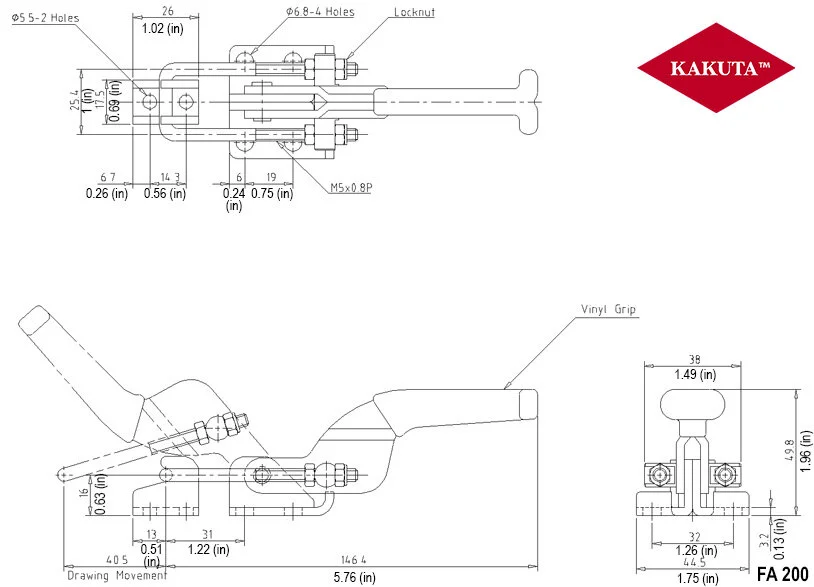
Most toggle clamps push. A vertical or horizontal hold-down presses a spindle down onto a part. A push-pull clamp drives a plunger in a straight line. A latch clamp does something different: it pulls. It reaches across a gap, hooks onto a catch and draws the two sides together.
This guide explains how a pull-action latch clamp works, where it fits best, how to mount and adjust it, and how to choose between the Kakuta FA 200 and FA 300.
What Is a Latch Toggle Clamp?
A latch toggle clamp is a toggle clamp that holds by pulling two surfaces together in tension. It is also called a pull-action clamp, a hook clamp or a draw-latch clamp.
It has two separate parts. The clamp body mounts on one side of the joint. The latch plate (also called the catch or keeper) mounts on the other side. When the clamp is closed, the hook pulls on the latch plate and locks the two parts together.
Our overview of the types of toggle clamps → shows where latch clamps sit next to hold-down and push-pull clamps. This post goes deeper into the latch type.
How Does a Pull-Action Latch Clamp Work?
Like every toggle clamp, a latch clamp uses an over-center linkage. Our guide on how toggle clamps work → explains the geometry in detail. Here is the pull-action sequence step by step:
- Engage. With the handle open, the operator places the hook over the latch plate.
- Draw. Closing the handle swings the linkage, which pulls the hook back toward the clamp body. The gap between the two parts closes.
- Lock. At the end of the stroke, the linkage passes just over center. Now the pull on the hook pushes the linkage further into its locked position instead of forcing it open.
- Hold. The two parts stay pulled together with no effort from the operator and no air or power supply.
- Release. Lifting the handle brings the linkage back over center. The tension drops, and the hook can be lifted off the latch plate.
The main parts
- Handle: the lever the operator moves. On the FA 200 and FA 300 it has a red vinyl grip.
- Base: the part that bolts to the fixture, door or frame.
- Linkage and pivots: the arms that create the over-center lock.
- Hook or U-bolt: the member that reaches across the gap and carries the pull.
- Latch plate: the catch on the opposite part. The FA 100, FA 200 and FA 300 are supplied with one.
A latch clamp holds along one line: the line from the hook to the latch plate. Mount the plate on that line, and the clamp does the rest.
Where Should You Use Latch Toggle Clamps?
Choose a latch clamp when two parts need to be pulled together and held closed, rather than pressed down onto a surface. Typical uses:
- Fixture lids and gates: holding a hinged cover or clamping bar shut over a part.
- Two-piece fixtures: pulling two fixture halves together around a part.
- Mold and die halves: closing two halves with repeatable tension.
- Access panels, doors and covers: keeping panels on machines, cabinets and enclosures firmly shut.
- Cases and containers: closing lids on equipment cases and transport boxes.
A latch is not a safety interlock. A latch clamp can hold a guard or access panel closed, but it does not stop a machine when the panel opens. Guarding on machinery must still meet the applicable rules, such as OSHA 29 CFR 1910.212 → in the United States.
Latch vs. Hold-Down vs. Push-Pull Clamps
| Clamp type | Holding action | Best for |
|---|---|---|
| Latch (pull-action) | Pulls two parts together through a hook and latch plate | Lids, gates, panels, mold halves, two-piece fixtures |
| Vertical / horizontal hold-down | Presses a spindle down onto the part | Holding parts flat against a fixture or table |
| Push-pull (straight-line) | Drives a plunger forward or back in a straight line | Pushing parts against side stops, closing fit-up gaps |
If the part must be held against forces from several directions, a hold-down is usually the better choice. A latch clamp is strongest along its own pull line.
Choosing a Kakuta FA Latch Clamp
Kakuta's latch-type clamps are the FA series. The FA 200 and FA 300 are the usual starting points:
| Model | Holding capacity | Notes |
|---|---|---|
| FA 200 | 700 lbs | Our most popular latch-type clamp. Supplied with latch plate. Stainless steel version: FA 200-2S. |
| FA 300 | 2,000 lbs | The highest holding capacity of the FA 100, FA 200 and FA 300. Supplied with latch plate. Stainless steel version: FA 300-2S. |
Size the clamp from the load it must resist, with a safety margin. Our guide What Is Clamping Force and Why It Matters → explains how to read a rating and apply a margin. You can compare every model in the latch type range →.
How Do You Mount and Adjust a Latch Clamp?
- Line up the latch plate. Mount it so the hook pulls in a straight line from the clamp. A side-loaded hook wears faster and can slip off.
- Mount both parts rigidly. Bolt the base and the latch plate to stiff material. Thin sheet can flex under the pull. Our installation guide → covers mounting in detail.
- Position the latch plate for the right tension. The clamp should pass over center with firm, steady effort. If it snaps shut with no resistance, the joint is not being pulled tight: move the plate further away. If it needs excessive force, move the plate closer.
- Check the closed position. Close the clamp and confirm the handle sits fully over center before you rely on it.
Common Mistakes to Avoid
- Using a latch clamp to press a part flat. That is a hold-down's job.
- Mounting the latch plate off the pull line, so the hook loads sideways.
- Choosing by size rather than by the load the joint must hold.
- Treating a latch on a machine guard as a safety interlock.
- Skipping inspection. Check pivots, hook and latch plate for wear as part of routine clamp maintenance →.
Conclusion
A latch clamp pulls two parts together and locks them over center, with no power and no ongoing effort. Use it for lids, gates, panels, mold halves and two-piece fixtures. Mount the latch plate on the pull line, position it so the clamp locks firmly, and size the clamp from the load. For most jobs, the FA 200 (700 lbs) or FA 300 (2,000 lbs) is the starting point.
Frequently Asked Questions
What is a latch toggle clamp?
A latch toggle clamp is a pull-action clamp. Closing the handle drives an over-center linkage that pulls a hook against a latch plate, locking two parts together. It holds without power or ongoing effort and opens with one movement of the handle.
How is a latch clamp different from a hold-down clamp?
A hold-down clamp presses a spindle down onto a part. A latch clamp pulls two parts together through a hook and a latch plate. Use a hold-down to hold a part flat, and a latch clamp to hold a lid, gate, panel or fixture half closed.
How much can a Kakuta latch clamp hold?
The FA 200 has a holding capacity of 700 lbs and the FA 300 has a holding capacity of 2,000 lbs. Size the clamp from the load the joint must resist, with a safety margin.
Do Kakuta latch clamps come with a latch plate?
Yes. The FA 100, FA 200 and FA 300 are supplied with a latch plate. Stainless steel versions of the FA 200 and FA 300 are available as the FA 200-2S and FA 300-2S.
Can a latch clamp be used to secure a machine guard?
It can hold a guard or panel closed, but it is not a safety interlock and does not stop a machine when the panel opens. Machine guarding must still meet the applicable safety rules, such as OSHA 29 CFR 1910.212 in the United States.
Request a quote for latch clamps
Tell us about your application and our team will help you choose the right FA latch clamp. Kakuta has manufactured precision toggle clamps since 1959.
Contact our team →Questo articolo è disponibile anche in italiano: Morsetto a ginocchiera a tirante →
