

Release-Lock Toggle Clamps: What the Secondary Lock Does and When to Specify One
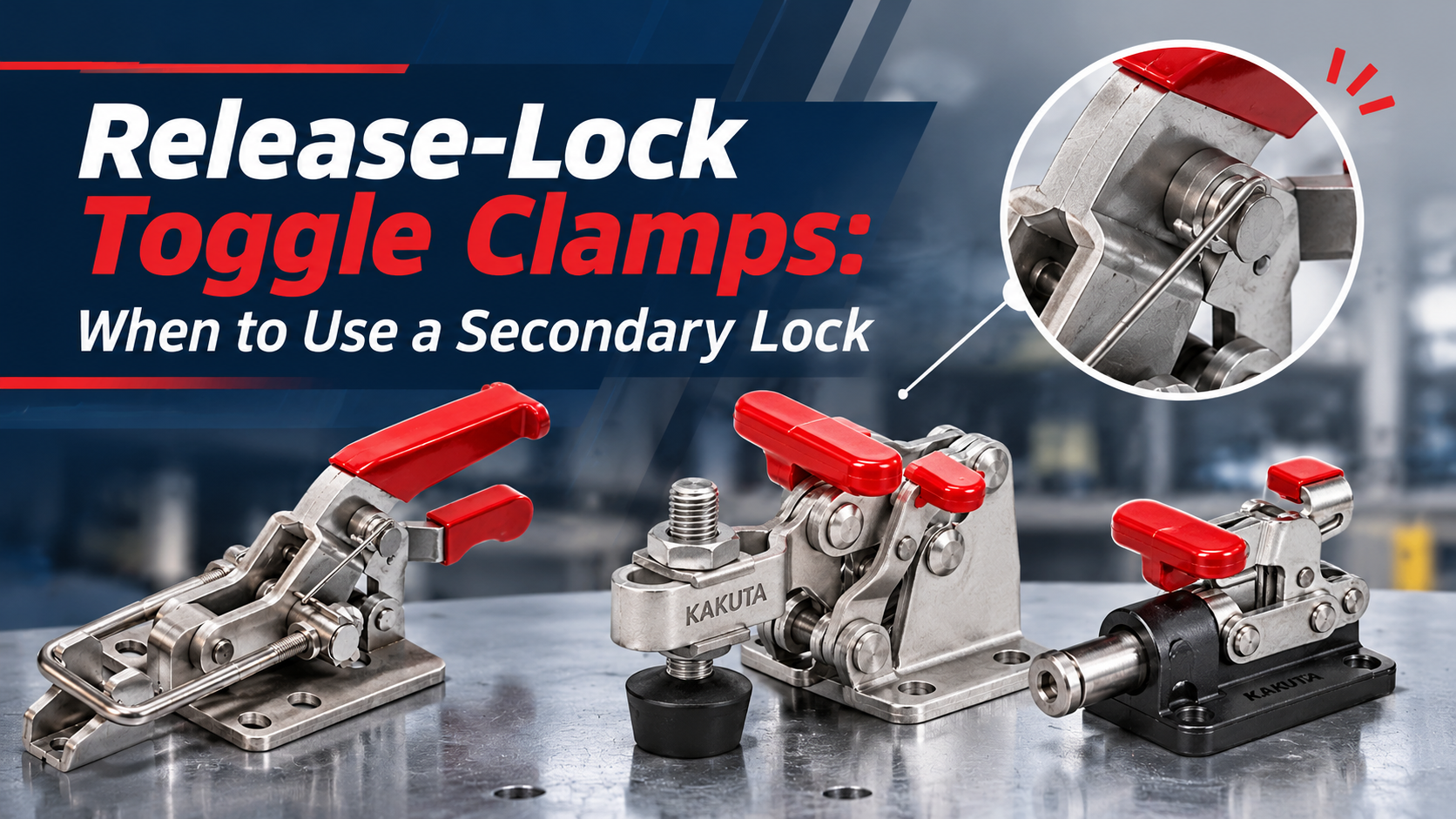
A standard toggle clamp holds because its linkage goes over center. A release lock toggle clamp adds a second lock on top of that, so the clamp stays closed until the operator deliberately releases it. Here is what that second lock is for, where it earns its place on a fixture, and which Kakuta models to look at.
How a Standard Toggle Clamp Holds, and Where It Can Let Go
Every toggle clamp works on the same principle. As you close the handle, the linkage pivots move past a straight line (the over-center point) and come to rest against a stop. In that position, the load on the spindle or plunger pushes the linkage further into the locked position instead of forcing it open. That is why a toggle clamp holds with no air, no power and no effort from the operator. Our guide to how toggle clamps work covers the geometry in detail.
The over-center lock is reliable, but it is a lock that one deliberate push on the handle undoes. In most fixtures that is exactly what you want: one motion to clamp, one to release. The trouble starts when something other than the operator pushes on the handle:
- Vibration from machining, grinding, hammering or a nearby press, working on the handle over a long cycle.
- Impact from a part, a tool, a hose or a sleeve catching the handle.
- Orientation: fixtures that rotate, tilt or move between stations, where gravity and inertia act on the handle in new directions.
- High cycle counts, where small amounts of wear in the pivots reduce how far the linkage sits past center.
What the Release-Lock Adds
A Release-Lock toggle clamp keeps the standard over-center mechanism and adds a secondary lock. Once the clamp is closed, that lock holds it closed until the operator releases it on purpose. A knock on the handle or steady vibration is no longer enough to open the clamp; opening it takes a separate, intentional action.
The practical result is that the clamp has two independent reasons to stay shut: the over-center geometry, and the lock. For fixtures where an unplanned release would scrap a part, damage tooling or put a hand at risk, that second layer is what the Release-Lock is for.
A secondary lock is not a machine guard. It reduces the chance of accidental release. It does not replace guarding, interlocks or a proper risk assessment of the cell. Treat it as one part of a safe fixture, not the whole answer.
When to Specify a Release-Lock Toggle Clamp
You don't need a Release-Lock on every fixture. Use this as a quick screen; if two or more of these apply, it is worth specifying one.
1. The fixture sees constant vibration
Milling, drilling, deburring and grinding fixtures, or fixtures mounted near presses and shakers. Vibration is the most common reason a standard clamp creeps open over a shift.
2. The station cycles all day
High-cycle assembly and inspection stations open and close clamps hundreds of times per shift. A secondary lock keeps the hold positive even as pivots wear.
3. The fixture moves
Rotary tables, trunnions, tilting welding positioners, carts and transfer fixtures change the direction of load on the handle. A lock stops the handle from swinging open when the fixture turns.
4. A release would be costly
Large or expensive parts, parts in final machining, or setups where a released part could fall or be thrown. Here the extra second of operator time is cheap insurance.
5. Handles are exposed
Crowded fixtures, handles near walkways, or clamps that robots, hoses or cables can brush past.
The Kakuta Release-Lock Range: Three Actions, Six Models
Kakuta builds Release-Lock versions across three clamping actions, so you can keep the action your fixture needs and add the secondary lock. (Not sure which action you need? Start with our guide to the types of toggle clamps.)
- Hold-down, vertical handle: HV 200-RL, HV 450-RL. The spindle presses down on the part. See the vertical handle range.
- Push, straight-line action: SL 70-RL. A plunger pushes the part against a stop, with 17.5 mm of plunger travel. See the straight-line action range.
- Latch, pull action: FA 200-RL, FA 300-RL, FA 700-RL. A hook draws two parts or fixture halves together and holds them. See the latch type range.
| Model | Action | Holding capacity | Spindle / thread |
|---|---|---|---|
| HV 200-RL | Hold-down, vertical handle | 68 kg (≈150 lb) | M5 × 0.8 |
| HV 450-RL | Hold-down, vertical handle | 227 kg (≈500 lb) | M8 × 1.25 |
| SL 70-RL | Push, straight-line | 136 kg (≈300 lb) | M6 × 1.0 |
| FA 200-RL | Latch, pull action | 320 kg (≈705 lb) | M5 × 0.8 |
| FA 300-RL | Latch, pull action | 900 kg (≈1,984 lb) | M8 × 1.25 |
| FA 700-RL | Latch, pull action | 3,400 kg (≈7,496 lb) | 1/2-12 |
Holding capacities and threads as printed on Kakuta's dimensioned drawings, in kg. Pound values are conversions for reference. For mounting dimensions, see the drawings or our guide to reading a toggle clamp spec sheet.
How to choose between them
- Pick the action first. Pressing down on a part: HV-RL. Pushing it sideways against a locator: SL-RL. Pulling a lid, gate or two fixture halves together: FA-RL.
- Then size by holding capacity. Estimate the force trying to move the part (cutting load, weld shrinkage, the weight of a swinging gate), apply a safety factor, and choose a model rated comfortably above it.
- Check the space for release. The operator needs room to reach the release as well as the handle, with gloves on.
Cross-Reference: Destaco and Carr Lane Equivalents
If you already specify Release-Lock-style clamps from another brand, these are the closest Kakuta equivalents. Destaco's locking versions carry the -R, -UR or -MR suffix.
| Kakuta | Destaco | Carr Lane |
|---|---|---|
| HV 200-RL | 305-UR | CL-200-LVTC |
| HV 450-RL | 207-UR | – |
| SL 70-RL | 6015-MR | – |
| FA 200-RL | 331-R | – |
| FA 300-RL | 341-R | – |
| FA 700-RL | 385-R | CL-500-LPA |
Equivalents are for selection guidance. Confirm mounting dimensions and capacity against the drawings before you swap a clamp on an existing fixture. More crosses are on our cross-reference page.
Have a Destaco or Carr Lane part number on a drawing? Send it to us and we'll quote the Kakuta Release-Lock equivalent.
Request a quote →Installation and Use Tips
- Mount rigidly. Bolt through every mounting hole into a flat, stiff plate. A clamp that flexes on its base loses the benefit of any lock. Our installation guide covers the steps.
- Set the spindle or latch first. Adjust the spindle height or latch hook so the clamp goes fully over center with the part in place. A clamp that only just closes is not fully locked.
- Train the release. Show operators the release action at handover so nobody forces the handle.
- Inspect on a schedule. On high-cycle stations, check pivots, the lock and the spindle for wear and spatter along with the rest of the fixture.
Conclusion
A release lock toggle clamp keeps everything that makes a toggle clamp useful (fast, power-free, repeatable) and adds a second lock that only the operator can release. Specify one where vibration, high cycle counts, moving fixtures or exposed handles make an accidental release likely, and where that release would be costly. Choose the action first, size by holding capacity, and use the cross-reference to move existing fixtures across.
Frequently Asked Questions
What is a release-lock toggle clamp?
A release-lock toggle clamp is a toggle clamp with a secondary lock in addition to the standard over-center lock. Once the clamp is closed, the secondary lock keeps it closed until the operator deliberately releases it, so vibration or a knock on the handle cannot open it.
When should I use a release-lock toggle clamp instead of a standard one?
Use one where the fixture sees constant vibration, cycles at high volume, rotates or moves between stations, has exposed handles, or holds parts where an accidental release would scrap the part or create a hazard.
Which Kakuta models have a release lock?
Kakuta's Release-Lock range includes the vertical-handle HV 200-RL (68 kg) and HV 450-RL (227 kg), the straight-line SL 70-RL (136 kg), and the latch-action FA 200-RL (320 kg), FA 300-RL (900 kg) and FA 700-RL (3,400 kg) holding capacity.
What are the Destaco equivalents of Kakuta Release-Lock clamps?
HV 200-RL crosses to Destaco 305-UR, HV 450-RL to 207-UR, SL 70-RL to 6015-MR, FA 200-RL to 331-R, FA 300-RL to 341-R and FA 700-RL to 385-R. HV 200-RL also crosses to Carr Lane CL-200-LVTC and FA 700-RL to Carr Lane CL-500-LPA.
Is a release-lock toggle clamp a safety device?
It reduces the risk of accidental release, but it does not replace machine guarding, interlocks or a risk assessment. Use it as one part of a safe fixture design.
Need a clamp that stays shut?
Tell us the part, the load and the clamp you use today. Kakuta USA will suggest the right Release-Lock model and quote it, shipping from Valencia, CA.
Request a quote Download the catalogue