

Heavy-Duty Toggle Clamps: How to Choose a VH Model by Holding Capacity
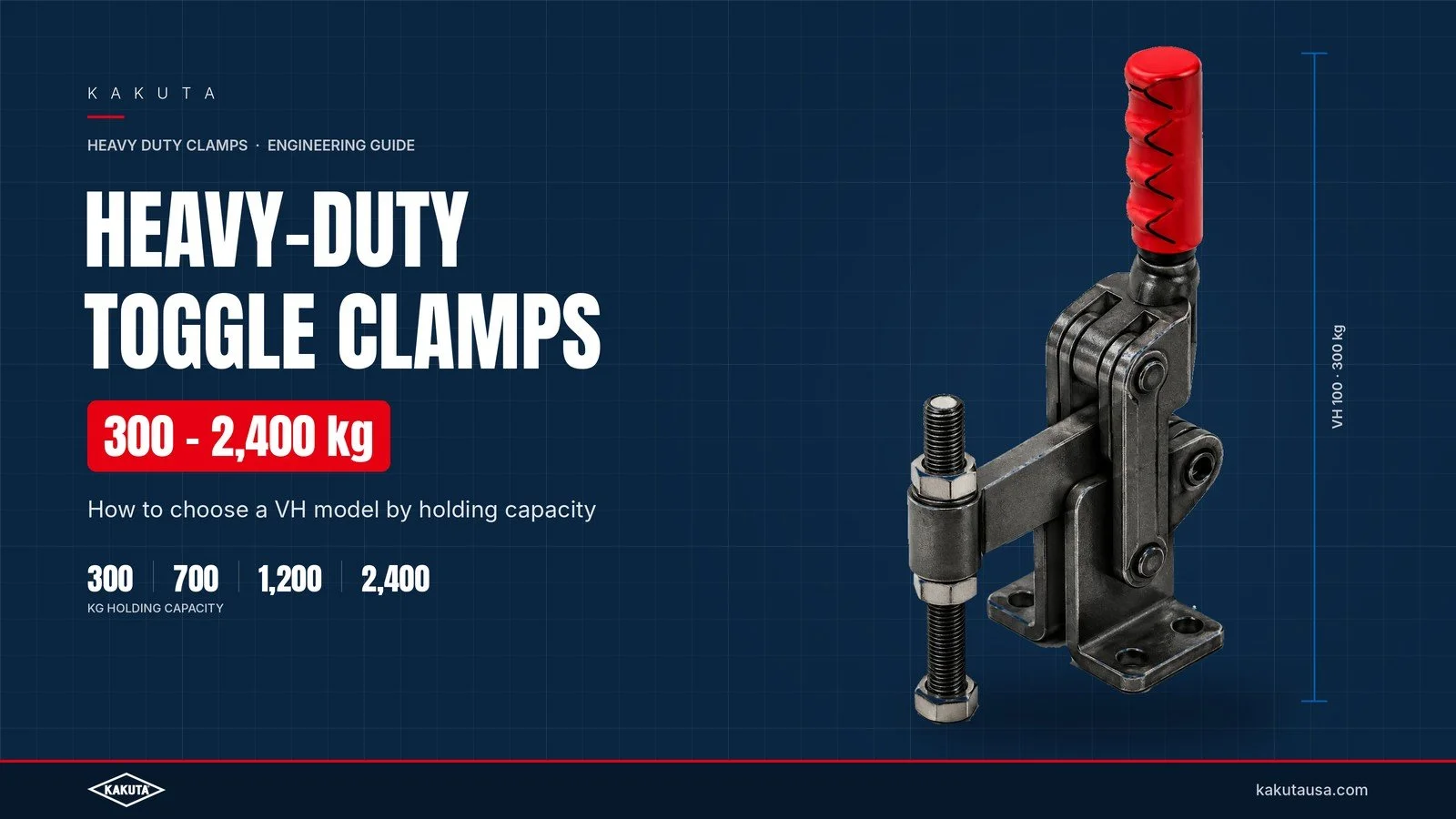
Heavy duty toggle clamps are vertical hold-down clamps built for loads that standard clamps are rated too close to. Kakuta's VH series covers four holding tiers, 300, 700, 1,200 and 2,400 kg. Choose by estimating the load, adding a safety margin, then picking the smallest tier that clears it and fits the fixture.
When Does a Job Need a Heavy-Duty Toggle Clamp?
A standard vertical-handle clamp is the right answer for most light fixturing: holding sheet metal for drilling, locating a part for inspection, keeping a panel flat for assembly. It stops being the right answer when the forces trying to move the part get close to what the clamp is rated for. (If you're still deciding between clamp actions, start with our guide to the types of toggle clamps.)
These are the usual signs that a fixture needs a heavy-duty clamp:
- Machining loads. Milling and drilling push and lift the part with every pass. Cutting forces are rarely steady, so the clamp sees peaks well above the average.
- Weld distortion. As a weld cools, it shrinks and pulls the part out of position. On a welding table, the clamp has to resist that pull, not just the part's weight.
- Heavy or large parts. Castings, thick plate and large weldments carry more mass and more inertia when the fixture moves.
- No margin left. If your calculation lands near the top of a standard clamp's rating, there is no headroom for wear, a worn spindle pad or an operator who doesn't fully close the handle.
- Clamps creeping or marking. A clamp that opens under load, or a part that shifts between operations, often means the clamp is undersized.
Holding Capacity Is the Number to Size By
Toggle clamp ratings come down to two different forces, and they're easy to mix up:
- Holding capacity is how much force the clamp resists in the closed, over-center position before it is forced open. This is the figure Kakuta prints on every VH drawing.
- Clamping force is the force the spindle actually applies to the part when you close the handle. It depends on spindle adjustment and is lower than the holding capacity.
Size the clamp by holding capacity against the load trying to move the part, then set the spindle so the clamp closes fully over center. Our guide to choosing the right clamping force for your fixture covers the calculation and the safety factor in detail, and how toggle clamps work explains why the over-center position holds without power.
The Kakuta VH Series: Four Heavy-Duty Tiers
Kakuta's VH heavy-duty vertical-handle clamps come in six models across four holding tiers. Within the 300 kg and 700 kg tiers there are two models with different geometry, so you can match the bar opening and footprint to the fixture.
| Model | Holding capacity | Bar opens | Handle travel | Shipping weight |
|---|---|---|---|---|
| VH 100 | 300 kg (≈661 lb) | 130° | 92° | 310 g |
| VH 101 | 300 kg (≈661 lb) | 202° | 125° | 290 g |
| VH 302 | 700 kg (≈1,543 lb) | 180° | 120° | 1,250 g |
| VH 303 | 700 kg (≈1,543 lb) | 205° | 130° | 1,180 g |
| VH 502 | 1,200 kg (≈2,646 lb) | 180° | 125° | 2,110 g |
| VH 602 | 2,400 kg (≈5,291 lb) | 195° | 130° | 4,100 g |
Values as printed on Kakuta's dimensioned VH drawings. Pound values are conversions for reference. For mounting dimensions, see the drawing for each model or our guide to reading a toggle clamp spec sheet.
What heavy-duty construction adds
The VH series is built with forged steel construction, hardened pivot pins and sealed bushings. Forging gives the arm and base the strength to carry heavy fixture and weld-table loads. Hardened pins keep the pivots from wearing loose over repeated cycles, so the clamp keeps closing to the same over-center position. Sealed bushings protect the pivot points from chips, coolant and grit on the shop floor.
How to Choose the Right Heavy Duty Toggle Clamp in Four Steps
1. Estimate the load on the part
Work out the largest force trying to move the part: the peak cutting force, the pull from weld shrinkage, the weight of the part if the fixture tilts, or the force of a press or insertion step. Use the peak, not the average.
2. Add a safety margin
Multiply the load by the safety factor your shop uses for fixtures. A larger factor makes sense where loads are hard to predict, such as interrupted cuts or welding thick sections, or where a release would be costly.
3. Pick the smallest tier that clears it
Choose the lowest VH tier whose holding capacity is above your result. For example, a 250 kg peak load with a factor of 2 gives 500 kg, so the 700 kg tier (VH 302 or VH 303) is the right step, not the 300 kg tier. Oversizing further adds weight and footprint without adding much.
4. Check the space and the geometry
Confirm the bar opens far enough to load and unload the part, that the handle has room to travel with a gloved hand, and that the base fits the mounting plate. This is where you choose between the two models in the 300 and 700 kg tiers.
Use more than one clamp when the part is long. Two clamps spaced along a part often hold better than one larger clamp in the middle, because they resist twisting as well as lifting. Check each clamp against its share of the load.
Where Heavy-Duty Vertical Clamps Work
- Machining fixtures: holding castings and plate against cutting forces on mills and machining centers.
- Welding tables: holding weldments against shrinkage and distortion. See our guide to toggle clamps for welding fixtures for placement and spatter protection.
- Assembly jigs: keeping large sub-assemblies in position during fastening and pressing.
- Drill and mill setups: quick-change setups on manual machines where the part has to be swapped fast.
- Production lines: fixtures that cycle all shift, where hardened pivots keep the hold repeatable.
If the fixture also sees heavy vibration or moves between stations, consider whether a secondary lock is worth adding. Our guide to Release-Lock toggle clamps covers when that applies.
Cross-Reference: Carr Lane HVTC Equivalents
If your drawings call out Carr Lane heavy-duty vertical clamps, these are the direct Kakuta equivalents.
| Kakuta | Holding capacity | Carr Lane |
|---|---|---|
| VH 100 | 300 kg | CL-100-HVTC |
| VH 101 | 300 kg | CL-101-HVTC |
| VH 302 | 700 kg | CL-302-HVTC |
| VH 303 | 700 kg | CL-303-HVTC |
| VH 502 | 1,200 kg | CL-502-HVTC |
| VH 602 | 2,400 kg | CL-602-HVTC |
Equivalents are for selection guidance. Confirm mounting dimensions against the drawings before you swap a clamp on an existing fixture. More crosses are on our cross-reference page.
Have a Carr Lane HVTC number on the order? Send it to us and we'll quote the Kakuta VH equivalent.
Request a quote →Installation Tips for Heavy Loads
- Mount on a stiff plate. At 700 kg and above, a thin or flexing plate becomes the weak point. Bolt through every mounting hole. Our installation guide covers the steps.
- Set the spindle with the part in place. Adjust it so the handle closes fully over center. A clamp that only just closes is not holding at its rating.
- Load through the spindle. Position the clamp so the load acts along the spindle, not sideways across the bar.
- Inspect on a schedule. Check pivots, spindle threads and pads for wear, spatter and chips along with the rest of the fixture.
Conclusion
Heavy duty toggle clamps earn their place where machining, welding or heavy parts push a standard clamp to the limit of its rating. Size by holding capacity, use the peak load with a safety margin, and pick the smallest VH tier that clears it: 300, 700, 1,200 or 2,400 kg. Then check the bar opening, handle travel and footprint, and use the cross-reference to move existing fixtures across.
Frequently Asked Questions
What is a heavy duty toggle clamp?
A heavy duty toggle clamp is a toggle clamp built for higher holding capacity than standard models, typically for machining fixtures, welding tables and heavy assembly work. Kakuta's VH series are heavy-duty vertical-handle hold-down clamps rated from 300 kg to 2,400 kg holding capacity.
How do I choose the right size of heavy duty toggle clamp?
Estimate the peak force trying to move the part, multiply it by your safety factor, and choose the smallest model whose holding capacity is above the result. Then check the bar opening, handle travel and mounting footprint on the drawing.
What is the difference between holding capacity and clamping force?
Holding capacity is the force a closed toggle clamp resists before it is forced open. Clamping force is the force the spindle applies to the part when the handle is closed, and it is lower than the holding capacity. Size the clamp by holding capacity.
Which Kakuta heavy-duty clamps are available?
The VH series includes the VH 100 and VH 101 (300 kg), VH 302 and VH 303 (700 kg), VH 502 (1,200 kg) and VH 602 (2,400 kg) holding capacity.
What are the Carr Lane equivalents of Kakuta VH clamps?
VH 100 crosses to Carr Lane CL-100-HVTC, VH 101 to CL-101-HVTC, VH 302 to CL-302-HVTC, VH 303 to CL-303-HVTC, VH 502 to CL-502-HVTC and VH 602 to CL-602-HVTC.
Not sure which tier you need?
Tell us the part, the load and the clamp you use today. Kakuta USA will suggest the right VH model and quote it, shipping from Valencia, CA.
Request a quote Download the catalogueKakuta has manufactured precision toggle clamps since 1959. Browse the full vertical handle range. Leggi questa guida in italiano.
